If you squat, bench press and deadlift, one of the simplest ways to measure your overall strength is your powerlifting total.
Your total combines your best squat, bench press and deadlift into a single number. It is the foundation of competitive powerlifting and one of the easiest ways to track whether you are getting stronger over time.
But a common question quickly follows:
“Is my powerlifting total actually good?”
A 500 kg total can mean very different things depending on your bodyweight, sex, experience, equipment and competition context. That is why your total is extremely useful — but it should not always be interpreted by itself.
This guide explains how a powerlifting total works, how to calculate yours, what it tells you about your strength, and when you should use a bodyweight-adjusted score such as DOTS instead.
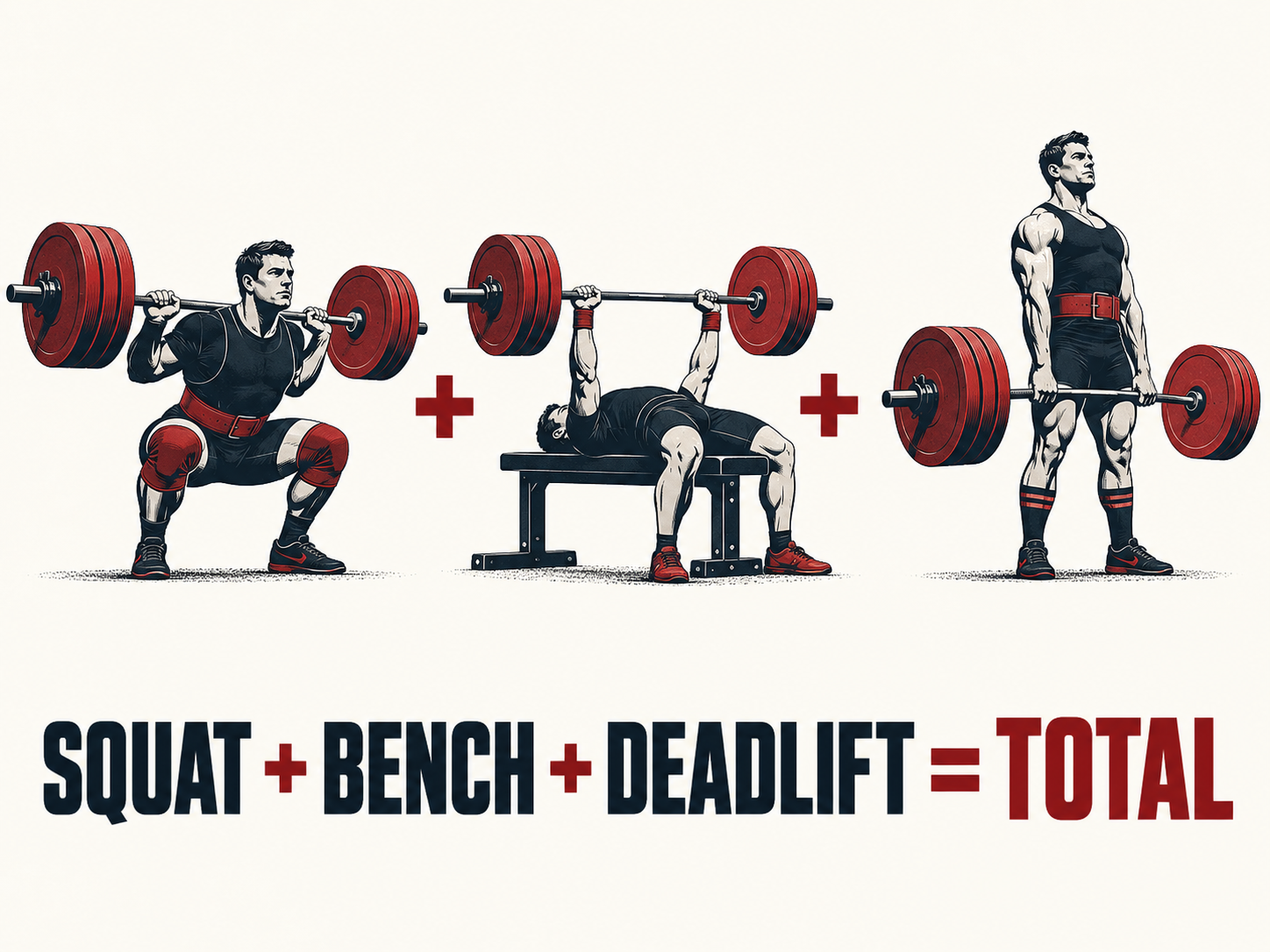
What Is a Powerlifting Total?
A powerlifting total is the combined weight of your best successful:
- Squat
- Bench press
- Deadlift
The calculation is simple:
Powerlifting Total = Squat + Bench Press + Deadlift
For example, if your best lifts are:
- Squat: 180 kg
- Bench press: 120 kg
- Deadlift: 220 kg
Your total is:
180 + 120 + 220 = 520 kg
In a full powerlifting competition, however, your total is based on your best successful competition attempt in each of the three lifts — not simply the best weights you have ever lifted in the gym.
How Is Your Competition Total Calculated?
In the example below, ✓ means a successful attempt and ✗ means a failed attempt.
In a standard full powerlifting competition, lifters perform the squat, bench press and deadlift.
You normally receive three attempts at each lift. Your best successful attempt from each discipline contributes to your final total.
Imagine your competition looks like this:
| Lift | 1st Attempt | 2nd Attempt | 3rd Attempt | Best Lift |
|---|---|---|---|---|
| Squat | 170 kg ✓ | 180 kg ✓ | 187.5 kg ✗ | 180 kg |
| Bench Press | 110 kg ✓ | 117.5 kg ✓ | 122.5 kg ✗ | 117.5 kg |
| Deadlift | 205 kg ✓ | 220 kg ✓ | 227.5 kg ✓ | 227.5 kg |
Your competition total would therefore be:
180 + 117.5 + 227.5 = 525 kg
The failed attempts do not contribute to the total.
Gym Total vs Competition Total
This distinction is important.
A gym total is usually the sum of the best squat, bench press and deadlift you have achieved in training.
A competition total is built from lifts successfully completed under the rules of a specific competition.
Those numbers are not always the same.
Competition lifts must satisfy the technical standards and referee commands of the federation. Fatigue also matters because all three disciplines are performed during the same competition.
For that reason, saying “I have a 600 kg gym total” is not necessarily the same as having officially totaled 600 kg in competition.
Both numbers can be useful — just make sure you know which one you are comparing.
Is My Powerlifting Total Good?
This is where the answer becomes more complicated.
There is no universal powerlifting total that automatically means “strong.”
Consider two lifters:
| Metric | Lifter A | Lifter B |
|---|---|---|
| Bodyweight | 67.5 kg | 120 kg |
| Squat | 180 kg | 220 kg |
| Bench | 120 kg | 150 kg |
| Deadlift | 220 kg | 260 kg |
| Total | 520 kg | 630 kg |
Lifter B has the larger absolute total: 630 kg versus 520 kg.
But Lifter A achieved 520 kg at a much lower bodyweight.
If the question is simply “Who lifted more total weight?”, the answer is straightforward: Lifter B.
If the question is “How do these performances compare relative to bodyweight?”, the raw total alone cannot answer it properly.
That is where scoring systems such as DOTS, Wilks and IPF GL become useful.
Absolute Strength vs Relative Strength
Understanding this difference makes powerlifting statistics much easier to interpret.
Absolute strength
Absolute strength describes how much weight you can lift regardless of your bodyweight.
If one lifter totals 700 kg and another totals 600 kg, the first lifter has the higher absolute powerlifting total.
Relative strength
Relative strength attempts to put that performance into the context of the lifter's body size.
Simply dividing your total by your bodyweight is one way to create a basic strength-to-weight ratio, but competitive powerlifting commonly uses more sophisticated scoring formulas because strength does not scale perfectly in direct proportion to bodyweight.
Systems such as DOTS, Wilks and IPF GL attempt to make comparisons between lifters of different bodyweights more meaningful.
For a detailed explanation, read our DOTS vs Wilks vs IPF GL comparison guide.
Why Bodyweight Changes the Meaning of a Total
Imagine two lifters both total exactly 600 kg.
One weighs 75 kg and the other weighs 110 kg.
Their absolute performance is identical: both moved a combined 600 kg across their best squat, bench press and deadlift.
But their performances occurred at very different bodyweights.
This is one reason powerlifting competitions use weight classes and why bodyweight-adjusted scoring systems exist.
Your total therefore answers one question very well:
How much did I lift?
It does not completely answer:
How does my performance compare with lifters of a different body size?
Should You Use Total or DOTS to Track Progress?
Ideally, use both — because they tell you different things.
Your total shows whether your combined squat, bench press and deadlift are increasing.
DOTS adds bodyweight context.
For example:
| Stage | Bodyweight | Total | What Changed? |
|---|---|---|---|
| Starting point | 90 kg | 500 kg | Baseline |
| Later | 90 kg | 540 kg | Higher total at same bodyweight |
| Later | 85 kg | 540 kg | Same total at lower bodyweight |
The first improvement is obvious: you added 40 kg to your total.
In the second example, your total did not increase, but maintaining the same 540 kg total at a lower bodyweight changes your relative-strength performance.
Looking at both metrics gives you more information than either number alone.
What Makes Up a Strong Total?
Your total is only the final number. Looking at how that number is distributed across the three lifts can reveal much more about your performance.
Two lifters can have exactly the same total with completely different strengths.
For example:
| Metric | Lifter A | Lifter B |
|---|---|---|
| Squat | 200 kg | 180 kg |
| Bench | 120 kg | 150 kg |
| Deadlift | 230 kg | 220 kg |
| Total | 550 kg | 550 kg |
Their totals are identical, but their individual lift profiles are clearly different.
That is why it can be useful to track your squat, bench press and deadlift separately in addition to tracking your total.
Why Your Total May Be Lower in Competition
Many lifters discover that adding together their gym personal records produces a higher number than their first competition total.
That is not unusual.
A competition introduces factors that may not exist during normal training:
- referee commands and technical standards,
- the need to successfully complete attempts,
- fatigue accumulated across squat, bench press and deadlift,
- limited recovery time,
- attempt selection,
- competition-day pressure.
A 200 kg squat performed successfully in the gym does not automatically guarantee a successful 200 kg competition squat.
Good attempt selection is therefore an important part of building the highest successful total on meet day.
Our Powerlifting Attempt Planner can help you plan your first, second and third attempts.
For practical guidance, read how to choose your opening, second and third attempts.
Why Going 9 for 9 Matters
In powerlifting, “going 9 for 9” means successfully completing all nine attempts: three squats, three bench presses and three deadlifts.
You do not need to go 9 for 9 to achieve a strong total. However, successful attempt selection gives you more opportunities to add kilograms to your final result.
Missing an overly aggressive second attempt, for example, can limit your options for the third attempt.
The goal on competition day is not simply to attempt the heaviest weights possible. It is to build the best successful total you can under the rules of the competition.
Does Your Total Include Failed Attempts?
No.
Only successful lifts count toward your competition total.
If you squat 200 kg successfully and then fail 210 kg, your best squat remains 200 kg.
The same principle applies to the bench press and deadlift.
What Happens If You Fail All Three Attempts?
Failing all three attempts in one discipline is commonly known as bombing out.
In a full powerlifting competition, this means you cannot establish a complete competition total.
This is another reason experienced lifters usually choose a first attempt that they expect to complete confidently.
How Should You Compare Your Total With Other Lifters?
Before comparing two totals, consider the context.
Useful factors include:
- bodyweight and weight class,
- sex,
- raw/classic versus equipped lifting,
- age division where relevant,
- competition versus gym lifts,
- the federation and applicable rules.
For lifters of substantially different bodyweights, a bodyweight-adjusted scoring system can provide additional context.
If you want to compare two performances directly, try our Compare Two Powerlifters Calculator.
Calculate Your Powerlifting Total
You do not need to calculate everything manually.
Enter your squat, bench press, deadlift and bodyweight into our calculator to see your total together with bodyweight-adjusted performance scores.
Calculate Your Powerlifting Total →
You can then use the result together with our DOTS vs Wilks vs IPF GL guide to understand what the different scoring systems mean.
Frequently Asked Questions
What is a powerlifting total?
A powerlifting total is the sum of your best successful squat, bench press and deadlift. In competition, the best valid attempt from each lift contributes to your final total.
How do I calculate my powerlifting total?
Add your squat, bench press and deadlift together. For example, a 200 kg squat, 130 kg bench press and 240 kg deadlift produce a 570 kg total.
Is a 500 kg powerlifting total good?
A total cannot be evaluated meaningfully from the number alone. A 500 kg total represents a different relative performance depending on factors such as bodyweight, sex, equipment and competition context. For comparisons across bodyweights, consider a scoring system such as DOTS in addition to the raw total.
Does bodyweight affect my powerlifting total?
Bodyweight does not change the arithmetic calculation of your total. A 600 kg total remains 600 kg regardless of bodyweight. Bodyweight becomes important when comparing performances between lifters or calculating bodyweight-adjusted scores.
Do failed attempts count toward my total?
No. Only successful attempts contribute to a competition total.
What does “9 for 9” mean in powerlifting?
It means successfully completing all three squat attempts, all three bench press attempts and all three deadlift attempts.
Is a gym total the same as a competition total?
Not necessarily. A gym total usually combines training personal records, while an official competition total consists of successful lifts performed under the rules and judging standards of the competition.
Should I track my total or DOTS?
Both can be useful. Your total tracks absolute combined performance, while DOTS provides additional bodyweight context. Tracking both can give you a more complete picture of your progress.
Final Takeaway
Your powerlifting total is one of the simplest and most useful numbers in the sport.
It tells you exactly how much weight you successfully lifted across the squat, bench press and deadlift.
But it is only one part of the picture.
Use your total to track absolute strength. Use DOTS, Wilks or another appropriate scoring system when bodyweight-adjusted comparison is relevant. And when comparing performances, make sure the competition conditions, equipment and scoring method are comparable.
Ultimately, the most useful comparison for long-term progress is often your current performance against your own previous performance.
Sources and Further Reading
- International Powerlifting Federation — Technical Rules
- OpenPowerlifting — Powerlifting Competition Results Database
- Powerlifting Calculator — Formulas & Methodology
- DOTS vs Wilks vs IPF GL — Which Powerlifting Score Should You Use?
Last updated: September 2026