Skip to content
POWERLIFTINGCALCULATOR
Menu ☰
Home / Compare Two Powerlifters: DOTS Score Calculator
POWERLIFTING CALCULATOR · PRACTICAL REFERENCE

Compare Two Powerlifters: DOTS Score Calculator

Use this tool to compare powerlifters of different bodyweights using the DOTS scoring formula. Enter both lifters’ bodyweights and powerlifting totals below. The calculator uses the same selected male or female DOTS coefficient set for both lifters. Therefore, the result compares their relative performance under the same formula rather than assigning an official competition placing. Compare powerlifters using DOTS score
Your unit selection is remembered for all calculators.
DOTS A: –
DOTS B: –
Winner: –
Share URL: –
Shared links contain the entered values. Anyone with the link can read them. Comparison uses DOTS.

Compare powerlifters using DOTS

DOTS helps compare performances across different bodyweights by applying a bodyweight coefficient to each lifter’s total. As a result, the comparison considers more than simply which lifter has the larger absolute total.

What the DOTS comparison measures

Each powerlifting total is multiplied by its own bodyweight coefficient. The calculator then subtracts the smaller DOTS score from the larger score to show the points gap. For lifters at the same bodyweight using the same coefficient set, a larger total will always produce a larger score. However, the result can be different when bodyweights are not the same. In that situation, the total alone is not enough to determine which performance receives more DOTS points.

Worked example: comparing two powerlifters

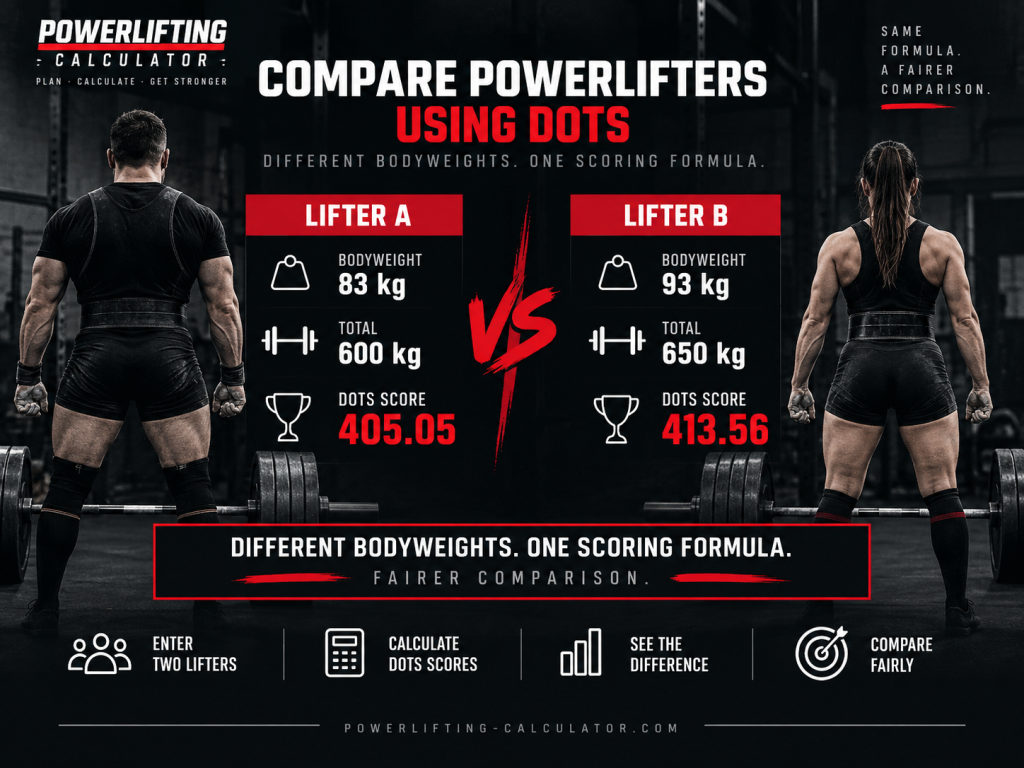
For example, consider two lifters using the male DOTS coefficients. A lifter weighing 83 kg with a 600 kg total produces approximately 405.05 DOTS. Meanwhile, a lifter weighing 93 kg with a 650 kg total produces approximately 413.56 DOTS. The difference between the two results is about 8.51 DOTS points. These values are illustrative examples calculated using the published formula, with rounding applied only for display.

Keep the comparison meaningful

For a useful comparison, choose totals from the same type of event and reasonably comparable conditions. For instance, a raw three-lift powerlifting total should not be treated as equivalent to an equipped bench-only result. In addition, this calculator uses one coefficient selector for both lifters. Therefore, it is not designed as a mixed male/female comparison calculator. The tool also does not apply age multipliers.

Absolute total versus relative strength

A larger powerlifting total represents greater absolute weight lifted. However, it does not automatically produce the higher bodyweight-adjusted score when the lifters have different bodyweights. DOTS provides additional context by adjusting each performance according to bodyweight. This makes it useful when you want to compare powerlifters who compete at different bodyweights. For a deeper explanation of bodyweight-adjusted scoring, read our DOTS vs Wilks vs IPF GL comparison guide.

Shared links and privacy

The “Copy share link” button includes the entered values in the URL. Therefore, anyone who receives that link can see those values. The URL may also appear in browser history, website logs or analytics data. For this reason, do not enter information that you do not want to share through the generated link. The calculator arithmetic itself runs in your browser.

When the DOTS scores are very close

The calculator displays scores rounded to two decimal places. Consequently, two displayed values may occasionally appear identical even when the underlying calculated values differ slightly. A displayed tie does not replace an official federation tie-break procedure. When interpreting an actual competition result, check the original results, the required scoring formula and the rules that applied to that event. Not sure whether DOTS is the right scoring system for your comparison? Learn when to use DOTS, Wilks or IPF GL.

Sources and further reading

Share this page:

Follow us on Facebook