POWERLIFTING SCORING FORMULAS
DOTS and Wilks both try to answer the same question: how strong is a lifter relative to bodyweight? But they use different equations, were developed from different datasets, and the same performance can produce different scores.
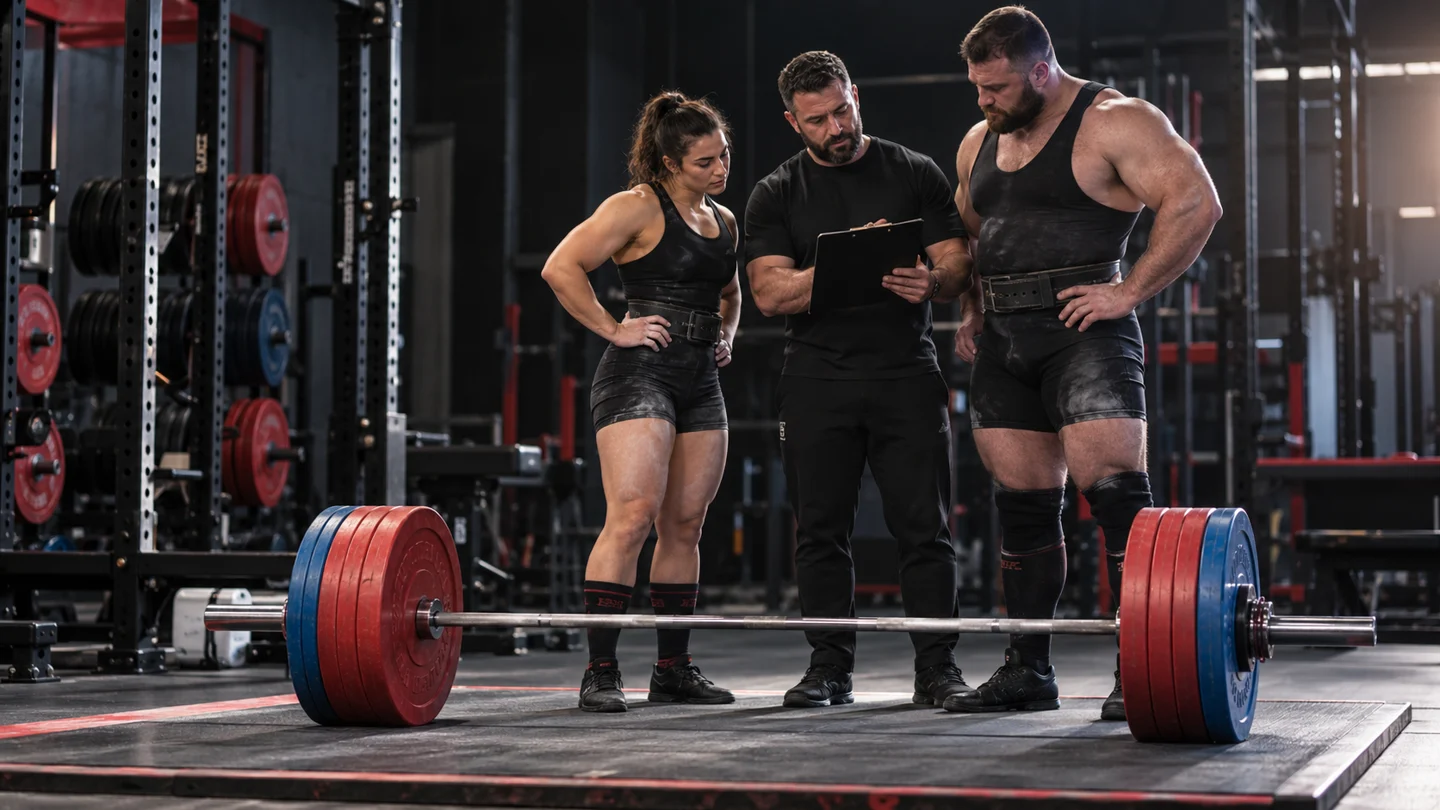
Bodyweight-adjusted scores help put lifted totals in context. AI-generated illustration.
DOTS vs Wilks at a Glance
Both formulas adjust a powerlifting total for bodyweight so lifters of different sizes can be compared on a common scale. The idea is similar, but the mathematical models are not the same.
| Feature | DOTS | Original Wilks |
|---|---|---|
| Main purpose | Bodyweight-adjusted strength comparison | Bodyweight-adjusted strength comparison |
| Inputs | Sex, bodyweight and total | Sex, bodyweight and total |
| Best use today | Modern general powerlifting comparisons | Historical results and events specifying classic Wilks |
| Used by IPF for official scoring? | No | No |
| Is there a universal conversion factor? | No. Recalculate from bodyweight and total. | |
A 400 DOTS score and a 400 Wilks score may look similar, but they come from different models. Identical numbers do not automatically represent identical relative performances.
What Is the DOTS Score?
DOTS is a bodyweight-adjusted scoring formula used to compare powerlifting performances across different bodyweights.
A lifter's total is adjusted using a bodyweight coefficient. Separate coefficient sets are used for men and women.
In practical terms, DOTS allows two lifters in different weight classes to compare performance on a more meaningful basis than total alone.
For a deeper explanation, see: What Is a Good DOTS Score?
What Is the Wilks Score?
The original Wilks formula was developed to compare lifters across different bodyweights using one adjusted score.
Like DOTS, it uses bodyweight, sex and total. The important difference is that it uses a different scoring curve, so the resulting numbers do not move exactly the same way as bodyweight changes.
OPENPOWERLIFTING DATA
DOTS vs Wilks in Real Competition Data
A useful comparison scores the same competition performances with both formulas. The live module below is designed for recent Raw full-power SBD results from OpenPowerlifting, using its recorded DOTS and original Wilks fields. Its sample size, date window and exclusions appear with the analysis when a dataset is available.
DOTS vs Wilks: OpenPowerlifting Comparison
Median DOTS − Wilks by bodyweight
| Scope | N | Median DOTS | Median Wilks | Median difference | Spearman | Top overlap |
|---|---|---|---|---|---|---|
| All included | 379,892 | 353.50 | 351.09 | +3.19 | 0.9981 | 72.0% |
| Men | 248,154 | 366.01 | 363.63 | +3.20 | 0.9988 | 80.0% |
| Women | 131,738 | 326.93 | 324.31 | +3.12 | 0.9968 | 79.0% |
What the data shows
- Across 379,892 included performances, DOTS and original Wilks rankings have a Spearman correlation of 0.9981.
- The median DOTS minus Wilks difference is 3.19 points; the sign and size of the difference vary with bodyweight.
- The top 100 performances overlap by 72.0% between DOTS and Wilks rankings.
- The largest absolute median score difference among bodyweight bands meeting the sample threshold appears in the 190-199.9 kg band at -20.63 points (n=65).
Methodology
- Source: OpenPowerlifting
- Source Url: https://www.openpowerlifting.org/
- Analysis Window: Last 3 years
- Cutoff Date: 2023-10-22
- Generated At: 2026-10-21T16:18:14.472132+00:00
- Event: SBD
- Equipment: Raw
- Sexes: M, F
- Required Fields: BodyweightKg, TotalKg, Dots, Wilks
- Bodyweight Bin Width Kg: 10
- Minimum Bodyweight Bin Size: 50
- Deduplication: Exact duplicate performances removed using lifter, date, meet, federation, bodyweight, total, DOTS and Wilks.
- Rank Correlation: Spearman correlation calculated from average ranks; ties receive average rank.
Limitations
- OpenPowerlifting coverage is broad but is not a complete census of every powerlifting competition worldwide.
- The analysis includes Raw full-power SBD performances only, so results should not be generalized automatically to equipped or single-lift competition.
- Original Wilks and DOTS are different scoring systems; a score difference is descriptive and is not itself evidence that one formula is more accurate.
- A single lifter can appear more than once if they competed in multiple meets; the unit of analysis is a competition performance, not a unique athlete.
- Bodyweight bands with fewer than 50 qualifying performances are omitted from the band chart.
- Rank-change metrics depend on the included sample and analysis window and should not be treated as universal constants.
Data source: OpenPowerlifting. DOTS and original Wilks values are read from the OpenPowerlifting dataset; analysis generated by Powerlifting Calculator.
Read rankings separately for men and women. A pooled summary combines two coefficient sets and is not an official mixed-sex best-lifter ranking. Meet entries are performances, so one athlete may appear more than once.
Worked Example: The Same Total, Two Different Scores
These are illustrative calculations using the male coefficient sets, bodyweight and total in kilograms, with points rounded only at the end. They are not real competition results.
| Example | Bodyweight | Total | DOTS | Classic Wilks |
|---|---|---|---|---|
| Lifter A | 83 kg | 600 kg | 405.05 | 400.50 |
| Lifter B | 93 kg | 650 kg | 413.56 | 408.32 |
Lifter B ranks higher under both formulas in this example. A's 405.05 DOTS and 400.50 Wilks describe exactly the same performance; the difference is not a strength gain. At a fixed bodyweight and within one coefficient set, both formulas are proportional to total. Across different bodyweights, their relative weighting changes.
Compare two lifters with DOTS, or use the DOTS and Wilks calculator to recalculate both scores from your own inputs.
Why Do DOTS and Wilks Give Different Scores?
Powerlifting performance does not scale linearly with bodyweight. A 120 kg lifter cannot simply be expected to lift twice as much as a 60 kg lifter.
Both DOTS and Wilks try to model that relationship, but they use different mathematical curves. Because the curves are different, the same total at the same bodyweight can produce a different adjusted score.
Do DOTS and Wilks Rank Lifters Differently?
They can. A formula changes how totals at different bodyweights are weighted. The worked example above preserves the ranking, but that is not guaranteed for every pair of performances.
When interpreting the live analysis, distinguish these measures:
- Spearman rank correlation: how similarly the two formulas order included performances; 1 means the same rank order, allowing for ties.
- Median DOTS minus Wilks: a difference between numerical scales, not an advantage in kilograms or evidence of better fairness.
- Top-N overlap: how many of the leading performances appear in both lists. It depends on the selected N and dataset.
- Bodyweight bands: descriptive summaries whose results can also reflect sex, total, federation and participant mix.
A high overall correlation can still hide changes among closely matched lifters. None of these measures establishes which formula is objectively fairer.
How Does DOTS Change Across Weight Classes?
Another useful question is whether typical DOTS scores differ across competition weight classes.
The table below uses recent OpenPowerlifting Raw full-power data and shows descriptive DOTS distributions by weight class.
DOTS by Weight Class — Men
| Weight class | N | Median DOTS | Mean | Q1 | Q3 | P90 |
|---|---|---|---|---|---|---|
| 30 kg | 50 | 127.11 | 129.66 | 110.75 | 146.18 | 172.87 |
| 35 kg | 96 | 149.36 | 151.85 | 127.11 | 173.51 | 198.61 |
| 40 kg | 78 | 178.91 | 178.36 | 152.53 | 199.56 | 224.04 |
| 44 kg | 63 | 187.66 | 188.57 | 154.51 | 211.55 | 246.05 |
| 48 kg | 69 | 183.42 | 179.53 | 139.12 | 208.8 | 229.29 |
| 51.7 kg | 225 | 244.52 | 251.17 | 210.12 | 288.33 | 325.19 |
| 52 kg | 991 | 243.09 | 247.08 | 196.99 | 288.99 | 341.89 |
| 53 kg | 843 | 324.47 | 316.86 | 260.44 | 380.96 | 413.3 |
| 55.7 kg | 258 | 268.72 | 270.64 | 240.94 | 299.18 | 330.71 |
| 56 kg | 1,318 | 295.01 | 298.38 | 242.26 | 354.92 | 407.4 |
| 59 kg | 3,583 | 368.55 | 360.79 | 310.24 | 416.72 | 454.78 |
| 59.8 kg | 389 | 273.81 | 274.25 | 238.78 | 306.99 | 340.83 |
| 60 kg | 2,826 | 323.75 | 319.62 | 260.82 | 378.74 | 420.52 |
| 62 kg | 140 | 373.63 | 351.52 | 299.46 | 417.59 | 445.47 |
| 66 kg | 9,021 | 373.17 | 369.62 | 327.67 | 416.91 | 457.29 |
| 67.1 kg | 666 | 274.2 | 277.53 | 234.66 | 311.68 | 351.5 |
| 67.5 kg | 8,276 | 343.88 | 338.2 | 288.3 | 391.43 | 430.97 |
| 69 kg | 286 | 366.7 | 368.69 | 325.33 | 417.77 | 462.88 |
| 74 kg | 17,992 | 372.79 | 371.18 | 330.26 | 413.94 | 454.29 |
| 74.8 kg | 749 | 287.54 | 287.63 | 247.02 | 328.15 | 357.11 |
| 75 kg | 14,748 | 355.79 | 351.32 | 308.37 | 399.92 | 438 |
| 77 kg | 445 | 360.88 | 363.25 | 319.75 | 409.41 | 454.29 |
| 82.1 kg | 691 | 284.17 | 284.7 | 241.43 | 321.66 | 364.8 |
| 82.5 kg | 18,676 | 361.68 | 358.53 | 318.21 | 403.91 | 440.7 |
| 83 kg | 26,287 | 373.97 | 373.36 | 333.82 | 416.03 | 454.11 |
| 83+ kg | 58 | 352.79 | 360.12 | 324.45 | 402.34 | 435.38 |
| 85 kg | 535 | 354.54 | 355.12 | 321.26 | 394.52 | 427.59 |
| 89.8 kg | 683 | 280.68 | 277.82 | 231.53 | 322.66 | 353.13 |
| 90 kg | 20,013 | 364.65 | 362.13 | 321.19 | 406.53 | 444.96 |
| 90+ kg | 41 | 360.69 | 360.07 | 327.45 | 386.8 | 416.12 |
| 93 kg | 27,460 | 376.11 | 374.6 | 335.26 | 415.96 | 452.7 |
| 93+ kg | 150 | 366.03 | 364.47 | 339.59 | 396.46 | 440.7 |
| 94 kg | 480 | 358.02 | 354.23 | 311.52 | 394.5 | 429.22 |
| 99.7 kg | 720 | 274.7 | 270.81 | 230.36 | 310.66 | 339.63 |
| 100 kg | 19,005 | 365.01 | 362.04 | 320.11 | 408.76 | 447.98 |
| 100+ kg | 43 | 357.4 | 355.21 | 322.56 | 386.06 | 403.72 |
| 105 kg | 20,089 | 378.92 | 376.37 | 336.52 | 419.78 | 456.41 |
| 105+ kg | 102 | 338.88 | 342.26 | 304.22 | 398.4 | 439.59 |
| 109.7 kg | 539 | 279.69 | 277.4 | 242.91 | 315.56 | 345.98 |
| 110 kg | 13,290 | 367.25 | 363.91 | 319.56 | 412.88 | 451.89 |
| 118 kg | 68 | 341.5 | 352.85 | 317.65 | 386.34 | 452.75 |
| 120 kg | 10,225 | 379.95 | 376.53 | 334.16 | 421.62 | 461.2 |
| 120+ kg | 4,997 | 370.97 | 366.7 | 321.49 | 414.71 | 455.89 |
| 124.7 kg | 548 | 278.99 | 275.46 | 242.89 | 307.69 | 333.87 |
| 125 kg | 9,082 | 364.64 | 361.5 | 310.99 | 412.37 | 455.5 |
| 139.7 kg | 294 | 287.28 | 281 | 248.39 | 315.72 | 339.97 |
| 139.7+ kg | 219 | 269.93 | 263.11 | 227.36 | 303.9 | 323.47 |
| 140 kg | 3,946 | 354.24 | 351.73 | 296.87 | 406.84 | 453 |
| 140+ kg | 2,517 | 347.47 | 348.75 | 289.59 | 407.76 | 456.14 |
What the data shows
- Among included men classes, the highest median DOTS is 379.95 in the 120 kg class (n=10225).
- The lowest included median is 127.11 in the 30 kg class (n=50); the descriptive median range is 252.84 DOTS.
- The highest 90th-percentile benchmark is 462.88 DOTS in the 69 kg class.
- These are descriptive differences between observed competition performances and should not be interpreted as a causal effect of weight class.
DOTS by Weight Class — Women
| Weight class | N | Median DOTS | Mean | Q1 | Q3 | P90 |
|---|---|---|---|---|---|---|
| 30 kg | 63 | 131.4 | 134.68 | 108.39 | 151.45 | 181.14 |
| 35 kg | 48 | 163.33 | 163.27 | 148.48 | 187.27 | 204.16 |
| 40 kg | 77 | 185.6 | 188.8 | 170.75 | 204.16 | 239.05 |
| 43 kg | 276 | 312.87 | 313.15 | 272.6 | 361.35 | 406.54 |
| 44 kg | 743 | 249.31 | 251.17 | 200.81 | 295.58 | 348 |
| 44.2 kg | 232 | 244.77 | 247.1 | 210.47 | 283.89 | 312.08 |
| 47 kg | 1,864 | 357.4 | 354.51 | 301.56 | 408.62 | 454.32 |
| 47.8 kg | 316 | 242.15 | 243.55 | 207.77 | 275.09 | 305.24 |
| 48 kg | 1,611 | 292.06 | 297.26 | 235.97 | 354.88 | 402.5 |
| 51.9 kg | 445 | 246.63 | 247.72 | 217.79 | 275.08 | 313.81 |
| 52 kg | 7,406 | 338.38 | 337.52 | 281.93 | 393.3 | 440.07 |
| 53 kg | 117 | 316.49 | 312.41 | 264.65 | 354.1 | 404.23 |
| 56 kg | 5,464 | 310.78 | 312 | 257.17 | 363.55 | 410.54 |
| 57 kg | 7,936 | 361.73 | 361.2 | 315.61 | 407.19 | 450.57 |
| 58 kg | 184 | 310.67 | 312.85 | 277.45 | 352.59 | 395.4 |
| 60 kg | 6,910 | 323.31 | 325.07 | 272.57 | 375.72 | 421.02 |
| 60+ kg | 49 | 336.52 | 336.16 | 298.29 | 361.18 | 394.38 |
| 60.1 kg | 623 | 247.67 | 249.38 | 209.86 | 284.56 | 314.58 |
| 63 kg | 11,310 | 355 | 355.13 | 309.36 | 400.33 | 442.94 |
| 63+ kg | 40 | 338.35 | 316.35 | 286.44 | 364.19 | 376.39 |
| 64 kg | 173 | 311.63 | 311.52 | 265.78 | 347.5 | 397.88 |
| 65 kg | 1,801 | 335.77 | 334.2 | 281.38 | 388.84 | 431.05 |
| 67.3 kg | 819 | 248.34 | 249.15 | 214.37 | 285.73 | 312.38 |
| 67.5 kg | 9,352 | 320.22 | 320.98 | 270.74 | 368.92 | 413.31 |
| 67.5+ kg | 36 | 337.06 | 348.36 | 305.52 | 383.04 | 413.65 |
| 69 kg | 11,863 | 351.78 | 353.37 | 308.99 | 397.67 | 441.4 |
| 69+ kg | 48 | 308.18 | 317.36 | 264.81 | 356.44 | 411.82 |
| 70 kg | 1,801 | 333.98 | 331.4 | 279.9 | 382.15 | 425.99 |
| 72 kg | 151 | 311.6 | 312.31 | 272.25 | 351.65 | 386.41 |
| 75 kg | 10,747 | 312.32 | 313.97 | 261.9 | 361.65 | 410.68 |
| 76 kg | 9,519 | 350.29 | 350.47 | 303.47 | 396.88 | 440.52 |
| 76+ kg | 59 | 332.49 | 322.02 | 281.49 | 365.83 | 401.34 |
| 80 kg | 67 | 315.88 | 313.01 | 283.02 | 340.96 | 383.43 |
| 82.3 kg | 556 | 236.25 | 236.31 | 200.22 | 268.88 | 297.29 |
| 82.5 kg | 7,368 | 310.16 | 311.26 | 264.95 | 356.16 | 401.4 |
| 84 kg | 6,492 | 339.37 | 340.16 | 292.85 | 386.68 | 432.64 |
| 84+ kg | 6,724 | 313.87 | 315.2 | 267.98 | 360.83 | 401.88 |
| 90 kg | 5,817 | 297.71 | 299.68 | 251.21 | 344.94 | 389.06 |
| 90+ kg | 347 | 278.43 | 286.26 | 245.31 | 323.19 | 370.24 |
| 100 kg | 4,301 | 292.12 | 295.27 | 244.75 | 342.44 | 385.9 |
| 100+ kg | 2,014 | 298.9 | 300.92 | 253.71 | 344.82 | 386.57 |
| 110 kg | 1,499 | 280.39 | 285.57 | 234.03 | 330.58 | 375.56 |
| 110+ kg | 1,150 | 285 | 284.57 | 237.74 | 326.5 | 366.47 |
| 117.5 kg | 306 | 234.78 | 233.99 | 201.87 | 265.75 | 300.94 |
| 117.5+ kg | 185 | 221.22 | 224.73 | 195.31 | 261.15 | 285.28 |
| 125 kg | 243 | 305.13 | 302.34 | 254.84 | 345.7 | 391.04 |
| 140 kg | 124 | 285.72 | 296.3 | 252.26 | 333.95 | 380 |
| 140+ kg | 35 | 300.07 | 310.63 | 256.28 | 373.34 | 411.85 |
What the data shows
- Among included women classes, the highest median DOTS is 361.73 in the 57 kg class (n=7936).
- The lowest included median is 131.4 in the 30 kg class (n=63); the descriptive median range is 230.33 DOTS.
- The highest 90th-percentile benchmark is 454.32 DOTS in the 47 kg class.
- These are descriptive differences between observed competition performances and should not be interpreted as a causal effect of weight class.
Methodology
- Source: OpenPowerlifting
- Source Url: https://www.openpowerlifting.org/
- Analysis Window: Last 3 years
- Cutoff Date: 2023-10-22
- Generated At: 2026-10-21T16:17:09.205552+00:00
- Event: SBD
- Equipment: Raw
- Sexes: M, F
- Minimum Group Size: 30
- Deduplication: Exact performance duplicates removed using lifter, date, meet, federation, class, total and DOTS.
- Statistics: Median, arithmetic mean, Q1 (25th percentile), Q3 (75th percentile), and P90 (90th percentile). Percentiles use linear interpolation.
Limitations
- OpenPowerlifting coverage is broad but not a complete census of every powerlifting competition worldwide.
- Weight-class rules and competitive depth vary across federations, countries and time periods.
- This is an observational comparison. Differences between weight classes should not be interpreted as being caused by bodyweight class itself.
- Only Raw full-power SBD performances with valid DOTS, total and weight-class data are included.
- A single lifter can appear more than once if they competed in multiple meets; the unit of analysis is a competition performance, not a unique athlete.
- Weight classes with fewer than 30 qualifying performances are omitted to reduce unstable small-sample summaries.
Data source: OpenPowerlifting. Analysis generated by Powerlifting Calculator.
These differences are descriptive. They should not be interpreted as proof that one weight class is inherently stronger than another.
Reading the table: N counts included performances; Q1 and Q3 are the 25th and 75th percentiles, and P90 is the 90th percentile. Weight-class labels come from different federations and are not one harmonised class system. Small groups and differences in age or participant mix can substantially affect their medians.
Recent High-DOTS Performances
To put the scoring system into real-world context, here are recent standout DOTS performances from OpenPowerlifting data.
Recent Standout DOTS Performances
| Lifter | DOTS | Total | Class | Federation | Date |
|---|---|---|---|---|---|
| Kyle Kirvay | 612.28 | 1115 kg | 140 | PLU | 2026-10-03 |
| Elias Brandecker | 599.95 | 940.5 kg | 93 | OEVK | 2026-10-10 |
| Sara Naldi | 596.4 | 520.5 kg | 57 | FIPL | 2026-10-11 |
| Carola Garra | 591.51 | 575 kg | 69 | FIPL | 2026-10-11 |
| Meghan Scanlon #1 | 590.61 | 575 kg | 69 | AMP | 2026-10-04 |
| Cassidy Conaghan | 590.24 | 442.5 kg | 47 | AMP | 2026-10-04 |
| Boris Tromp | 588.91 | 895 kg | 90 | WRPF-UK | 2026-10-03 |
| Gustav Hedlund | 585.44 | 922.5 kg | 105 | AMP | 2026-10-04 |
These examples help show what very high DOTS scores look like in real competition results rather than in theoretical examples.
This is a selection from the recent snapshot, not an all-time ranking. Equipment and federation rules can differ; a DOTS score does not make raw, wraps and equipped performances equivalent.
DOTS vs Wilks vs IPF GL
DOTS and Wilks are not the only scoring systems used in powerlifting. The International Powerlifting Federation uses IPF GL Points for best-lifter and relative-performance points. Ordinary weight-class placings still follow the applicable total and tie-break rules.
| Formula | Best suited for |
|---|---|
| DOTS | General modern cross-bodyweight comparison |
| Original Wilks | Historical results and events specifying classic Wilks |
| Wilks 2020 | Comparisons specifically using the revised Wilks model |
| IPF GL | IPF best-lifter and relative-performance points |
Want a deeper comparison? Read our DOTS vs Wilks vs IPF GL guide →
Which Powerlifting Score Should You Use?
Use DOTS if…
You want a modern general-purpose way to compare totals across bodyweights.
Use Wilks if…
You are comparing historical results or an event that specifies a Wilks formula. Check whether it requires classic Wilks or Wilks 2020.
Use IPF GL if…
You are interested in official IPF scoring.
Can You Convert DOTS to Wilks?
There is no reliable fixed DOTS-to-Wilks conversion factor.
To calculate Wilks, you need the lifter's:
- bodyweight
- sex
- total
Then Wilks must be calculated independently using its own formula. The same applies when converting from Wilks to DOTS.
If sex and bodyweight are known, a known score also lets you recover the implied total and calculate the other score. The conversion then depends on the two bodyweight coefficients; a score alone is insufficient. Prefer the original total to avoid extra error from rounded points.
What Is a Good DOTS Score?
A DOTS score should always be interpreted in context. Sex, equipment, age, competition level and federation depth can all affect what a typical score looks like.
Instead of relying only on broad labels such as “advanced” or “elite,” it is better to compare yourself against real competition data.
Read our full guide: What Is a Good DOTS Score?
CALCULATE YOUR SCORE
See Your Own DOTS Score
Enter your bodyweight and total and compare your performance across different bodyweights.
Calculate Your DOTS Score Explore Powerlifting TotalsDOTS vs Wilks FAQ
Is DOTS the same as Wilks?
No. Both formulas adjust powerlifting performance for bodyweight, but they use different equations and coefficients.
Is DOTS better than Wilks?
Neither formula is universally better for every purpose. DOTS is useful for consistent general comparisons; use the specified Wilks version for events or records that require it. Formula fairness needs evidence, not a comparison of the size of the scores.
Does the IPF use DOTS?
No. The IPF uses IPF GL Points for relative-performance awards, including best lifter. Weight-class placings follow the event rules.
Can I compare a DOTS score directly with a Wilks score?
You can view both scores, but they should not be treated as identical measurements. The best comparison is to calculate both from the same bodyweight and total.
Can you convert Wilks to DOTS?
There is no universal fixed conversion. Recalculate using sex, bodyweight and total; if total is unavailable, those first two inputs and a known score can recover an approximate total.
Why do DOTS and Wilks rankings differ?
They use different scoring curves. That means lifters at different bodyweights can receive slightly different relative weighting depending on which formula is used.