Bodyweight can change your DOTS score even when your squat, bench press and deadlift total stays exactly the same. In general, a lighter lifter receives a higher DOTS score for the same total because DOTS applies a bodyweight coefficient to the result. The size of that difference depends on bodyweight, sex and the total being scored.
This guide uses the published DOTS formula to show exactly how much bodyweight can change the score, with calculated examples rather than strength labels or estimates.
Quick answer: does lower bodyweight increase DOTS?
Yes, if the lifted total stays the same. DOTS multiplies your powerlifting total by a coefficient that changes with bodyweight. If two lifters use the same sex-specific formula and both total 600 kg, the lighter lifter will normally receive the higher DOTS score.
But that does not mean losing weight automatically improves your DOTS. If your total falls during a cut, the lower total can cancel out the benefit of weighing less. Use your actual recorded bodyweight, not the upper limit of your weight class. The useful question is therefore not simply “Will I weigh less?” but:
How much of my total can I keep at the lower bodyweight?
Want to check your own numbers? Use the DOTS & Wilks calculator and enter your measured bodyweight together with your squat, bench press and deadlift.
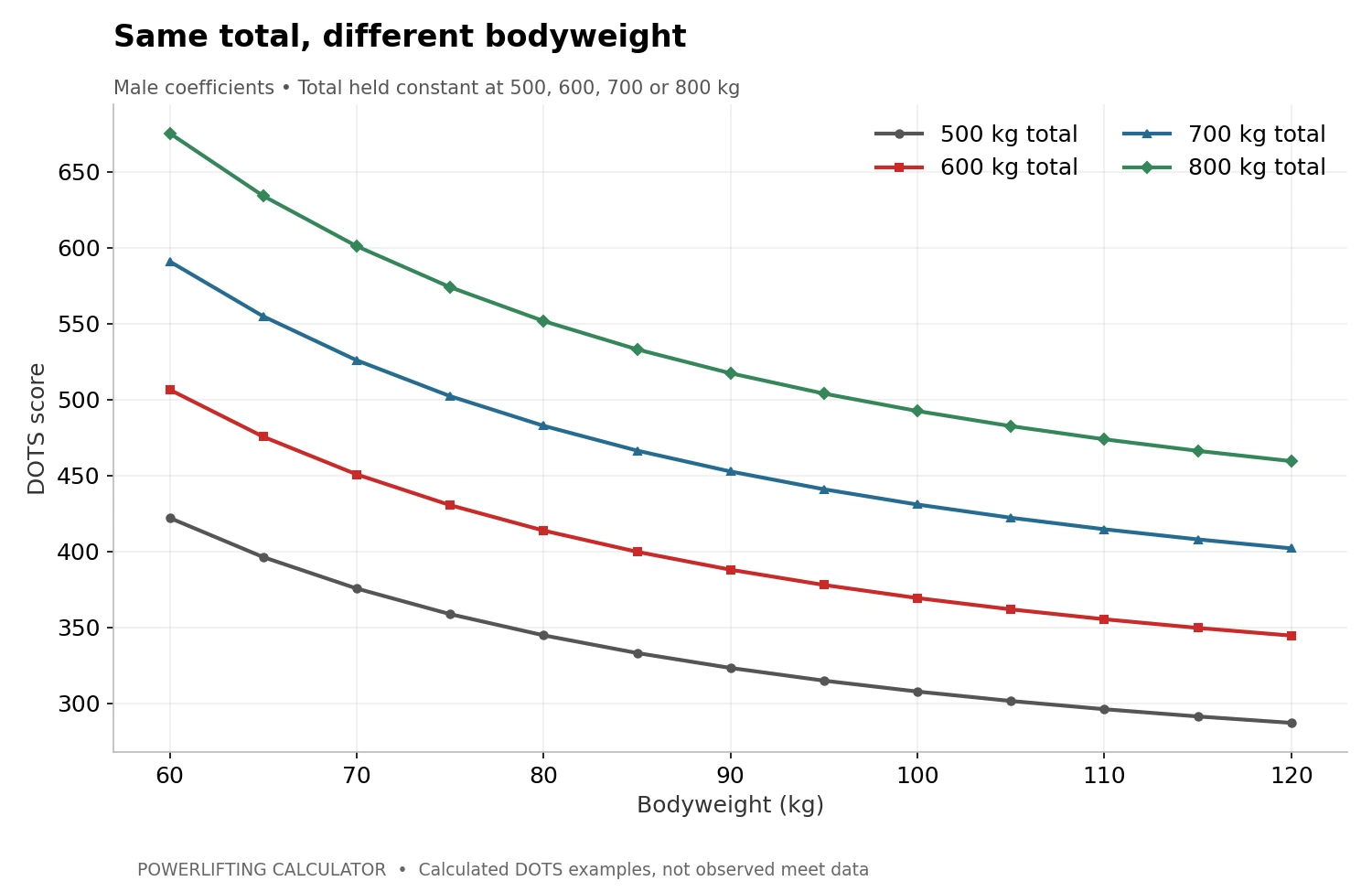
Same total, different bodyweight
The table below holds the powerlifting total constant and changes only bodyweight. It uses the male DOTS coefficients. Each cell is calculated directly from the published DOTS equation. These are controlled mathematical examples, not averages from competition results or strength standards.
| Bodyweight | 500 kg total | 600 kg total | 700 kg total | 800 kg total |
|---|---|---|---|---|
| 60 kg | 422.02 | 506.43 | 590.83 | 675.23 |
| 70 kg | 375.58 | 450.69 | 525.81 | 600.92 |
| 80 kg | 344.77 | 413.73 | 482.68 | 551.64 |
| 90 kg | 323.30 | 387.96 | 452.62 | 517.28 |
| 100 kg | 307.76 | 369.31 | 430.86 | 492.41 |
| 110 kg | 296.13 | 355.36 | 414.59 | 473.81 |
| 120 kg | 287.15 | 344.58 | 402.01 | 459.44 |
Example: a 600 kg total
A male lifter totaling 600 kg at 90 kg bodyweight scores about 387.96 DOTS. At 80 kg bodyweight, the same 600 kg total scores about 413.73 DOTS. That is an increase of approximately 25.77 DOTS, or about 6.6%, without changing the total.
The reason is simple: DOTS is designed to adjust a lifting result for bodyweight. The total still matters directly, but the coefficient changes as bodyweight changes.
If you want to compare two different lifters rather than one lifter at different bodyweights, use the Compare Powerlifters tool.
What happens to DOTS if your bodyweight changes but your total stays the same?
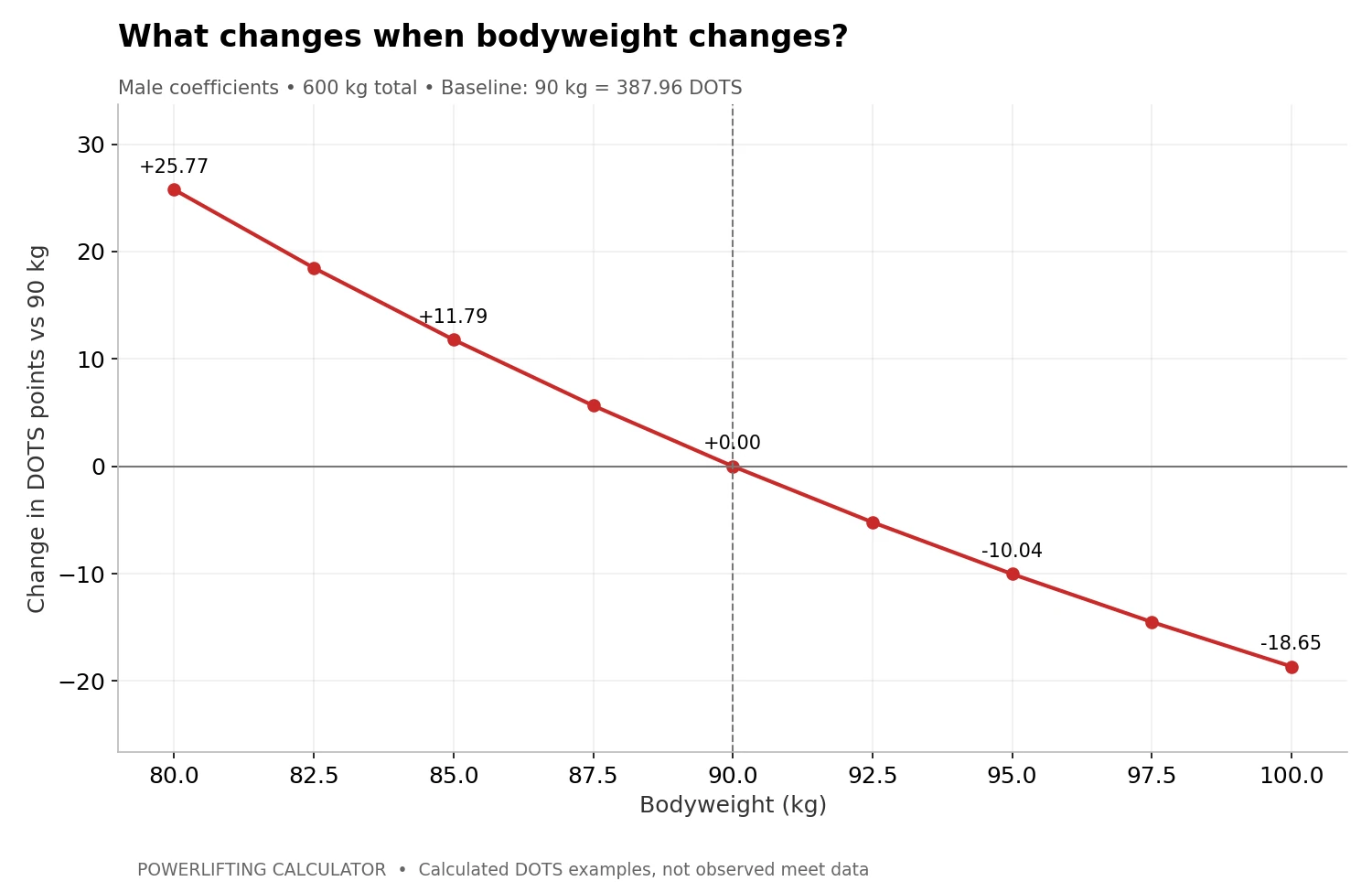
Here is a more realistic example centred on a male lifter with a 600 kg total at 90 kg bodyweight. The lifting total stays fixed at 600 kg and only bodyweight changes.
| Bodyweight | DOTS | Change vs. 90 kg | Percent change |
|---|---|---|---|
| 80 kg | 413.73 | +25.77 | +6.64% |
| 85 kg | 399.75 | +11.79 | +3.04% |
| 87.5 kg | 393.61 | +5.65 | +1.46% |
| 90 kg | 387.96 | Baseline | Baseline |
| 92.5 kg | 382.75 | -5.22 | -1.34% |
| 95 kg | 377.92 | -10.04 | -2.59% |
| 100 kg | 369.31 | -18.65 | -4.81% |
This example shows why a small change in scale weight usually produces a relatively modest DOTS change. Dropping from 90 kg to 87.5 kg while maintaining the full 600 kg total adds about 5.65 DOTS. A larger 10 kg reduction to 80 kg adds much more, but maintaining exactly the same strength after a large weight loss may be difficult in practice.
What total do you need to keep the same DOTS?
This is often the more useful question for a competitive lifter.
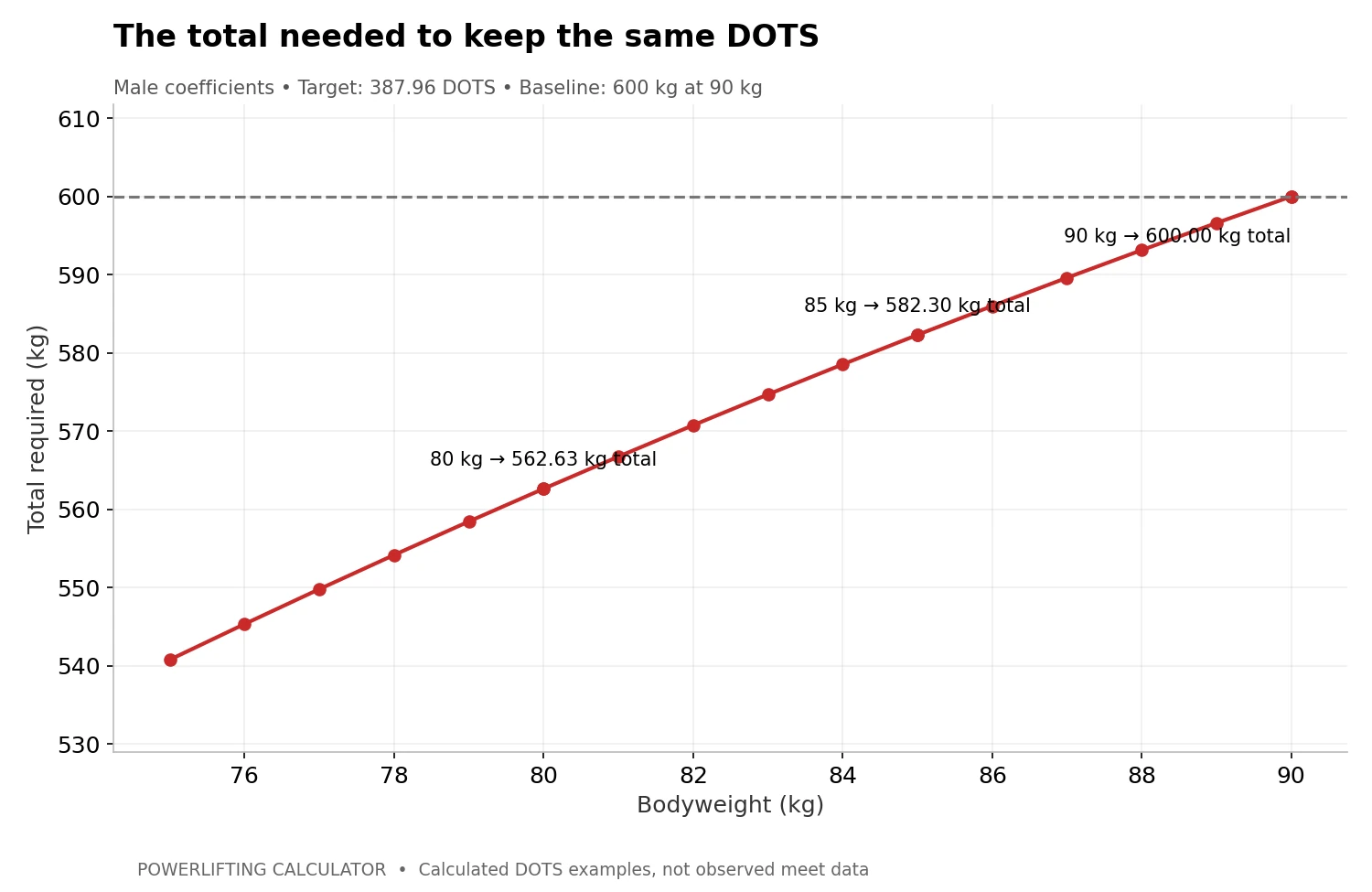
Start with the same example: 90 kg bodyweight, 600 kg total, 387.96 DOTS. If bodyweight falls, the total does not have to remain exactly 600 kg to preserve the same score.
| New bodyweight | Total needed for same DOTS | Total loss that still matches baseline |
|---|---|---|
| 87.5 kg | 591.38 kg | 8.62 kg |
| 85 kg | 582.30 kg | 17.70 kg |
| 80 kg | 562.63 kg | 37.37 kg |
For example, the lifter could move from 90 kg to 85 kg and total about 582.3 kg while still producing approximately the same DOTS score as 600 kg at 90 kg bodyweight.
Meet-day rounding matters: the break-even total is a mathematical value, not necessarily an achievable total. If your applicable increments require totals in 2.5 kg steps, 582.30 kg means you need at least 582.5 kg to match or exceed the baseline. Follow your event’s actual increment rules.
That does not make cutting weight automatically beneficial. DOTS only scores the bodyweight and result entered into the formula. It does not predict whether you will retain your total at a different bodyweight or whether changing bodyweight is appropriate for you.
Female DOTS examples: same total at different bodyweights
DOTS uses a separate coefficient set for women, so male and female calculations should not be mixed. The table below uses the published female coefficients.
| Bodyweight | 300 kg total | 400 kg total | 500 kg total |
|---|---|---|---|
| 50 kg | 375.9 | 501.2 | 626.5 |
| 60 kg | 332.6 | 443.4 | 554.3 |
| 70 kg | 303.4 | 404.5 | 505.6 |
| 80 kg | 282.7 | 376.9 | 471.1 |
| 90 kg | 267.5 | 356.6 | 445.8 |
| 100 kg | 256.0 | 341.3 | 426.7 |
Female worked example: a 400 kg total scores 404.50 DOTS at 70 kg and 443.42 DOTS at 60 kg. That is a mathematical comparison with the total fixed, not a recommendation to lose 10 kg.
The pattern is the same: with the total held constant, the lower bodyweight receives the higher DOTS score. However, the exact values differ because the female formula uses different polynomial coefficients.
Why does bodyweight change the score?
DOTS does not calculate relative strength by simply dividing total by bodyweight. Instead, it applies a bodyweight-dependent polynomial coefficient.
DOTS = Total × 500 ÷ (a·BW⁴ + b·BW³ + c·BW² + d·BW + e)
Here, BW is bodyweight in kilograms and the coefficients depend on the selected male or female formula. Because the denominator changes non-linearly with bodyweight, the effect of adding or losing one kilogram is not identical at every bodyweight.
The break-even total formula
Let P(BW) be the polynomial in the denominator. To keep your score unchanged:
New total = Old total × P(new bodyweight) ÷ P(old bodyweight)
For the male 90 kg / 600 kg example, this gives 600 × P(85) ÷ P(90) = 582.301259… kg. Calculations use full precision; rounding happens only for display.
Our calculator applies bodyweight boundaries of 40–210 kg for male coefficients and 40–150 kg for female coefficients. Outside those boundaries it substitutes the nearest limit and reports the substitution. All examples here are inside the boundaries. Age does not change DOTS.
For the full coefficient table, implementation details and calculation limits used on this site, see our calculator methodology. If you are new to the score itself, start with What Is a DOTS Score?.
What these numbers do — and do not — tell you
1. A lower bodyweight can improve DOTS without improving your total
If your total stays unchanged, a lower bodyweight can produce a higher score. That is a mathematical consequence of the scoring formula, not evidence that you became stronger in absolute terms.
2. A higher total can outweigh the bodyweight disadvantage
A heavier lifter can still score higher if the additional bodyweight comes with enough additional total. DOTS is not a “lighter is always better” system; it combines bodyweight and performance.
3. Cutting to a lower weight class is not guaranteed to improve your score
Your score only improves if the benefit from a lower bodyweight is greater than the effect of any lost kilos on your total. For planning, compare realistic totals at both bodyweights instead of assuming that the current total will survive a cut unchanged.
4. Compare like with like
Use the same formula, equipment category and type of result when tracking progress. A gym total, a meet total and results produced under different rules are not automatically interchangeable.
5. DOTS is a comparison tool, not a weight-cutting prescription
The formula does not account for hydration, fatigue, recovery, individual health considerations or how a weight cut affects performance. Competition strategy should not be based on the coefficient alone.
Worked example: 90 kg versus 85 kg bodyweight
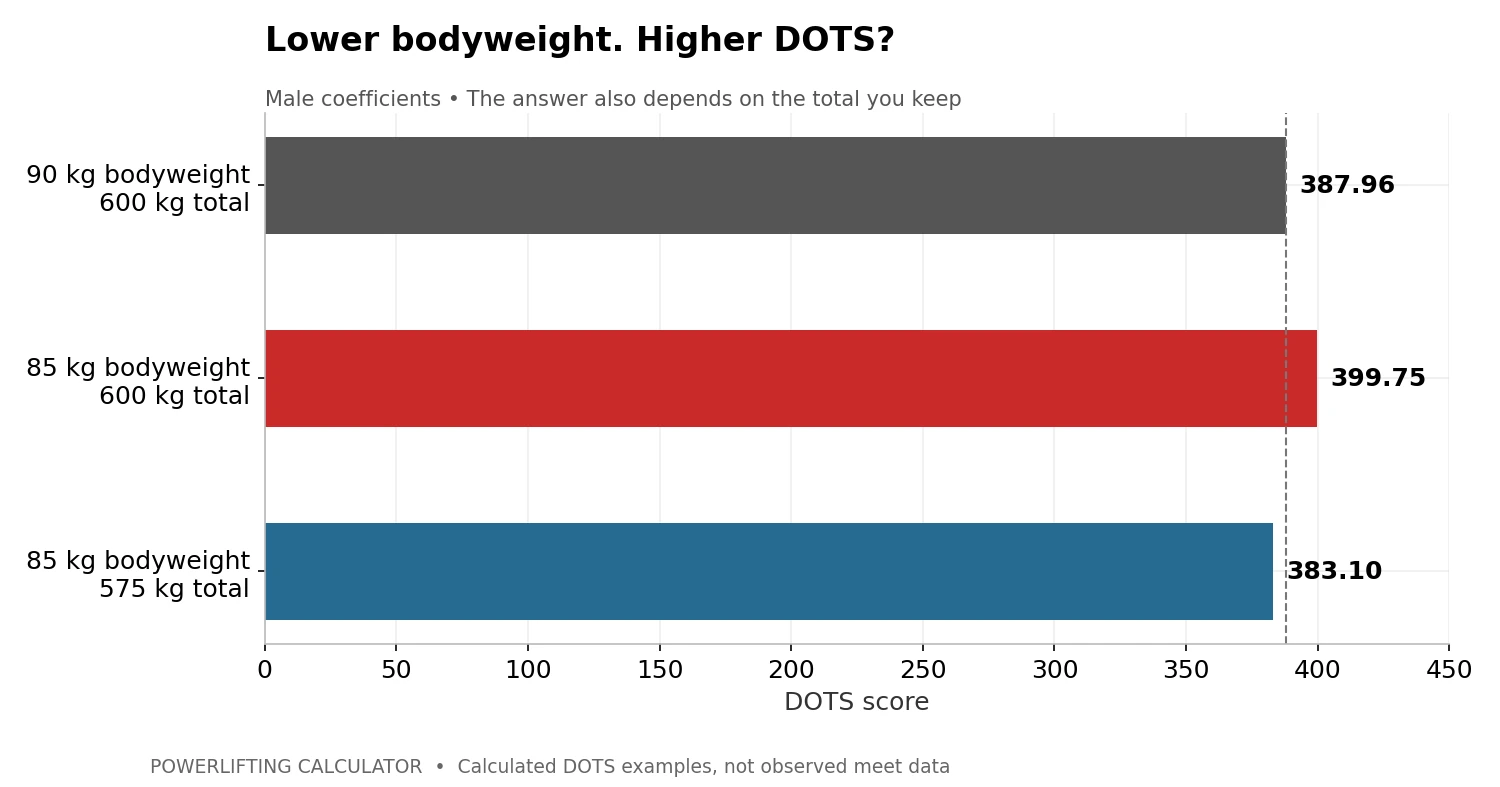
Suppose a male lifter currently weighs 90 kg and expects a 600 kg meet total:
- 90 kg bodyweight + 600 kg total = 387.96 DOTS
If he reaches 85 kg and keeps the full 600 kg total:
- 85 kg bodyweight + 600 kg total = 399.75 DOTS
That is a gain of about 11.79 DOTS. But if his expected total falls to 575 kg after the cut:
- 85 kg bodyweight + 575 kg total ≈ 383.10 DOTS
In that scenario, weighing less would actually produce a slightly lower DOTS score than staying at 90 kg and totaling 600 kg. The break-even total at 85 kg is about 582.30 kg.
This is why a useful weight-class decision should compare realistic performance scenarios, not bodyweight alone.
Calculate your own bodyweight scenario
Try your current bodyweight and total first. Then change only the bodyweight and calculate again. Finally, lower the total to a realistic post-cut estimate and compare the results.
Open the DOTS & Wilks Calculator →
You can also use Compare Powerlifters to place two bodyweight-and-total combinations side by side.
Frequently asked questions
Does losing 5 kg always increase your DOTS score?
No. It increases the bodyweight advantage in the formula, but your final DOTS also depends on the total you lift. If your total drops enough, the score can stay unchanged or decrease.
How much does 1 kg of bodyweight change DOTS?
There is no single fixed answer. DOTS uses a non-linear bodyweight coefficient, so the effect of one kilogram depends on your bodyweight, sex and total. The same one-kilogram change does not produce an identical DOTS change for every lifter.
Can two lifters with the same total have different DOTS scores?
Yes. If their bodyweights differ, their DOTS coefficients differ. For example, using the male formula, a 600 kg total at 80 kg bodyweight is about 413.73 DOTS, while the same 600 kg total at 100 kg is about 369.31 DOTS.
Does gaining bodyweight always lower DOTS?
If the total remains exactly the same, increasing bodyweight will generally reduce the score within the normal scoring range. But if the added bodyweight helps you increase your total enough, your final DOTS can still rise.
Should I choose a weight class based on DOTS?
DOTS can be one input, but it should not be the only one. Consider expected meet performance, recovery, the weigh-in format, competition rules and the effect of any weight cut on your total.
Is DOTS the same as IPF GL or Wilks?
No. DOTS, IPF GL and Wilks are different scoring systems with different formulas. Scores from different systems should not be treated as interchangeable. See our scoring guides for explanations and comparisons.
Methodology note
All numerical examples in this article were calculated from the published DOTS polynomial using bodyweight in kilograms and the stated powerlifting total. Values are rounded for readability, so recalculating with full precision may produce very small rounding differences.
For a competition total, use the best successful squat, bench press and deadlift from the same meet. If you need a refresher, see How to Calculate a Powerlifting Total.
Formula source: Tim Konertz’s original DOTS publication. Numerical tables and figures: our calculations using that polynomial. Bodyweight-change percentages use the unrounded 90 kg baseline; displayed differences may vary by 0.01 if you subtract already-rounded scores. The female table uses one decimal; the male tables use two.
These examples use bodyweights, not federation weight-class boundaries. To check the applicable category, use the weight class checker and confirm your event’s rules.
DOTS is a comparison score, not a medical or weight-management recommendation. Official competition rules and the scoring method selected by the organiser determine official placings.