If you have ever compared powerlifting results online, you have probably seen several different numbers attached to the same performance: DOTS, Wilks, and IPF GL Points.
All three systems try to solve the same basic problem: how can we fairly compare lifters of different bodyweights?
A 60 kg lifter and a 120 kg lifter obviously should not be compared only by the number of kilograms on the bar. At the same time, simply dividing the total by bodyweight does not accurately reflect how human strength scales with body size.
That is why powerlifting uses mathematical scoring formulas.
In this guide, we will look at how DOTS, Wilks and IPF GL work, why their scores are different, and — most importantly — which one you should use.
Quick Answer
There is no single scoring system that is correct for every situation.
- DOTS is useful for modern general powerlifting comparisons and is widely used outside the IPF system.
- Wilks is especially useful when comparing performances with historical results that were originally scored using Wilks.
- IPF GL Points should be used when comparing performances within the International Powerlifting Federation (IPF) system.
The most important rule is simple:
Compare lifters using the same scoring formula.
A DOTS score should be compared with another DOTS score, a Wilks score with another Wilks score, and IPF GL Points with other IPF GL Points.
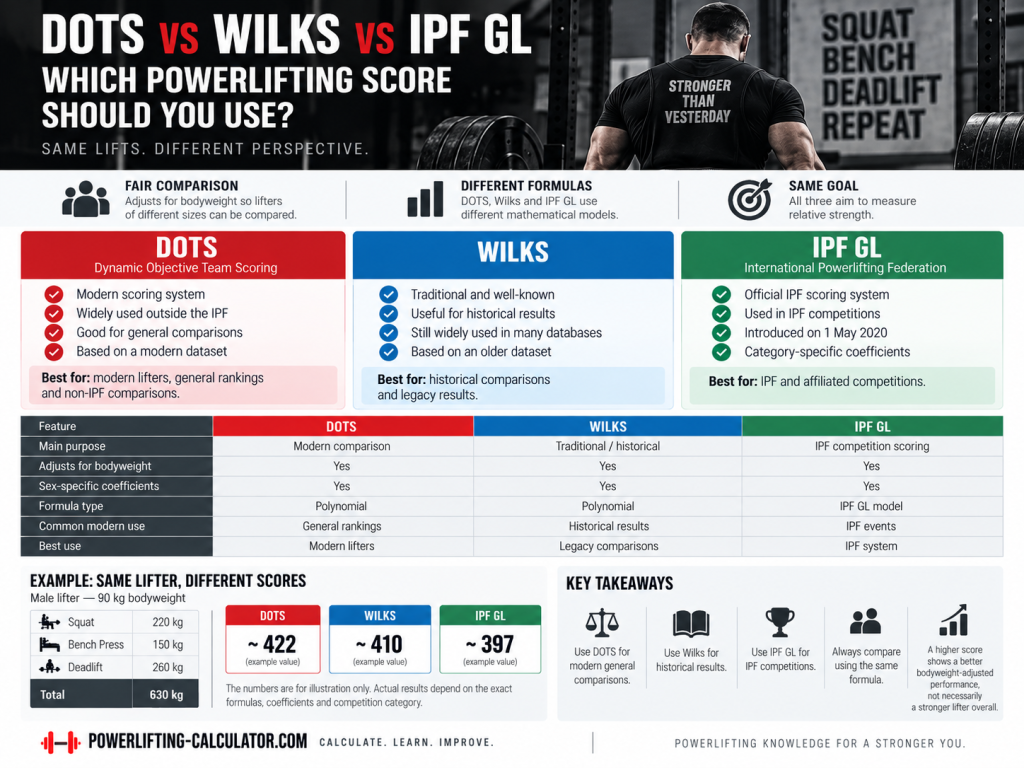
Why Do Powerlifting Scoring Formulas Exist?
Imagine two lifters:
- Lifter A weighs 70 kg and totals 500 kg.
- Lifter B weighs 110 kg and totals 650 kg.
Lifter B clearly has the larger absolute total.
But does that automatically mean that Lifter B produced the better performance relative to body size?
Not necessarily.
Powerlifting scoring formulas attempt to normalize performance across different bodyweights. Instead of comparing only kilograms lifted, they apply a mathematical coefficient based primarily on the lifter's bodyweight and sex.
The general idea looks like this:
Powerlifting Score = Competition Total × Bodyweight Coefficient
The important difference between DOTS, Wilks and IPF GL is how that coefficient is calculated.
What Is the Wilks Score?
The Wilks formula is one of the best-known bodyweight-adjusted scoring systems in powerlifting.
It was developed by Robert Wilks and became widely used for comparing lifters across weight classes.
The original Wilks coefficient is calculated using a fifth-degree polynomial based on the lifter's bodyweight.
In simplified form:
Wilks Score = Total × Wilks Coefficient
Separate coefficients are used for male and female lifters.
Why Wilks became popular
Wilks provided a much more useful comparison than simply dividing the weight lifted by the lifter's bodyweight.
For many years it became one of the standard ways to determine overall or "best lifter" performances across weight classes.
The limitation of Wilks
The original Wilks formula was based on older competition data. As powerlifting developed and much larger datasets became available, questions arose about how accurately the formula represented modern lifters across the full bodyweight range.
The International Powerlifting Federation eventually moved away from Wilks and introduced its own scoring systems.
Wilks is therefore extremely useful when looking at historical powerlifting results, but you should always check which version of the formula was used.
What Is DOTS?
DOTS stands for Dynamic Objective Team Scoring.
It was developed as a newer bodyweight-adjusted scoring method using a more modern dataset of powerlifting performances.
Like Wilks, DOTS converts a lifter's competition total into a score that can be compared across different bodyweights.
The basic concept is:
DOTS Score = Total × DOTS Coefficient
The DOTS coefficient uses a fourth-degree polynomial with separate coefficients for men and women.
Why DOTS is popular
DOTS has become a common general-purpose scoring system for modern powerlifting comparisons, particularly outside the IPF scoring system.
It is useful for:
- comparing lifters from different weight classes,
- tracking your own relative strength over time,
- comparing performances in databases and rankings that use DOTS,
- comparing lifters when no federation-specific scoring method is required.
For many recreational and competitive powerlifters, DOTS is therefore a practical modern reference score.
What Are IPF GL Points?
IPF GL Points are the scoring system used by the International Powerlifting Federation.
The IPF introduced GL Points after evaluating its previous scoring method and concluded that a new calculation would provide a better balance across weight classes.
IPF GL Points became valid for IPF-sanctioned events on 1 May 2020.
Unlike DOTS and the original Wilks formula, IPF GL uses a different mathematical model.
In simplified form:
IPF GL Points = 100 × Total / Reference Performance
The reference performance depends on factors including bodyweight, sex and competition category.
Why IPF GL is important
If you compete in the IPF or an affiliated federation using IPF scoring, IPF GL Points are the relevant comparison metric.
IPF GL also distinguishes between different competition types where applicable, including Classic and Equipped lifting.
This makes IPF GL more specifically tied to IPF competition than a general-purpose score such as DOTS.
DOTS vs Wilks vs IPF GL: Key Differences
| Feature | DOTS | Wilks | IPF GL |
|---|---|---|---|
| Main purpose | Modern general powerlifting comparison | Traditional / historical comparison | IPF competition scoring |
| Adjusts for bodyweight | Yes | Yes | Yes |
| Sex-specific coefficients | Yes | Yes | Yes |
| Formula type | Polynomial | Polynomial | IPF GL mathematical model |
| Common modern use | General rankings and non-IPF comparisons | Historical results and legacy comparisons | IPF and relevant affiliated competition |
| Best use | Comparing modern lifters across bodyweights | Comparing against older Wilks-based results | Comparing performances within the IPF system |
Example: The Same Lifter Under Different Scoring Systems
Consider a male lifter with:
- Bodyweight: 90 kg
- Squat: 220 kg
- Bench Press: 150 kg
- Deadlift: 260 kg
His powerlifting total is:
220 + 150 + 260 = 630 kg
That same 630 kg total can produce different numerical scores under DOTS, Wilks and IPF GL.
This does not mean that one calculator is wrong.
Each system uses a different mathematical model and its own coefficients.
That is why you should never directly compare, for example, a 420 DOTS score with a 420 Wilks score or with an IPF GL score.
They are different measurement systems.
Can You Convert Wilks to DOTS?
Not reliably with a simple conversion factor.
You may occasionally see people trying to convert a Wilks score into DOTS by multiplying it by a fixed number.
That does not work correctly because the difference between the formulas changes with bodyweight and sex.
The correct approach is to calculate both scores independently using the same:
- bodyweight,
- sex,
- competition total.
The same applies when comparing either score with IPF GL Points.
Which Score Should You Use?
If you want to compare modern powerlifters
DOTS is a useful general-purpose reference, especially when the federation or ranking system you are using reports DOTS.
If you are looking at historical powerlifting results
Use the scoring system reported with those results.
If an older competition used Wilks, comparing its lifters using the original Wilks score preserves the historical context.
If you compete in the IPF
Use IPF GL Points.
That is the scoring system specifically designed for and used in IPF competition.
If you are tracking your own progress
Consistency matters more than switching between formulas.
Choose one scoring system and keep using the same one.
For example, if your DOTS increases from 350 to 370 while your bodyweight remains similar, that gives you a useful indication that your performance relative to bodyweight has improved.
Does a Higher DOTS or Wilks Score Always Mean a Stronger Lifter?
It means a better bodyweight-adjusted performance according to that particular formula.
That distinction matters.
A scoring formula does not measure every aspect of strength.
It does not tell you:
- who has the largest absolute total,
- who has the biggest squat, bench press or deadlift,
- who performed better under different judging standards,
- how difficult the attempts felt,
- or whether two performances came from comparable competition conditions.
A coefficient is a statistical comparison tool — not a perfect definition of who is "stronger."
Why Your Score Can Change Without Getting Stronger
Your DOTS, Wilks or IPF GL score depends on both your total and your bodyweight.
For example, imagine you total 600 kg at 95 kg bodyweight.
Later you still total 600 kg, but now weigh 90 kg.
Your absolute strength has not changed — the total is still 600 kg — but your bodyweight-adjusted score will generally improve because you achieved the same performance at a lower bodyweight.
The opposite can happen if you gain bodyweight without increasing your total enough to compensate.
Absolute Strength vs Relative Strength
This leads to an important distinction in powerlifting.
Absolute strength asks:
"How much weight did you lift?"
Relative strength asks:
"How impressive was that performance relative to your bodyweight?"
Your competition total measures the first.
DOTS, Wilks and IPF GL attempt to estimate the second.
Both are useful — they simply answer different questions.
Should You Chase a Higher DOTS Score?
DOTS can be a useful way to track progress, but it should not become the only goal of your training.
A lifter may improve by:
- increasing their competition total,
- improving technique,
- moving into a more appropriate weight class,
- improving attempt selection,
- or maintaining strength while reducing unnecessary bodyweight.
Your score is best treated as one performance indicator among several.
Calculate Your Own DOTS and Wilks Scores
The easiest way to understand the difference is to calculate your own performance.
Enter your:
- sex,
- bodyweight,
- squat,
- bench press,
- deadlift.
Compare DOTS, Wilks Classic and Wilks 2020 using the same inputs. This website does not currently calculate IPF GL points; use the official IPF resources below for that system.
Calculate Your Powerlifting Score →
If you want to compare two athletes directly, you can also use our
Compare Two Powerlifters Calculator.
Frequently Asked Questions
Is DOTS better than Wilks?
They are different scoring systems developed from different models and datasets. DOTS is commonly used for modern general powerlifting comparisons, while Wilks remains important for historical results and competitions that used it. The appropriate formula depends on the context.
Does the IPF use DOTS?
No. The International Powerlifting Federation uses IPF GL Points for its sanctioned competitions.
When did the IPF start using GL Points?
The IPF states that the new IPF GL Points became valid on 1 May 2020.
Can I compare DOTS and Wilks scores directly?
No. Although the numbers may sometimes look similar, they are calculated using different coefficients. Compare DOTS with DOTS and Wilks with Wilks.
Does DOTS include age?
No. Standard DOTS scoring accounts for bodyweight and sex, not age. Masters competitions may use separate age-adjustment systems.
Does DOTS include whether I lift raw or equipped?
DOTS itself does not make raw and equipped performances directly equivalent. Competition context should therefore be considered when comparing results. IPF GL uses category-specific coefficients where applicable.
Can I use these formulas for a single lift?
These scoring systems are primarily associated with competition performance and should be used according to the rules and coefficients applicable to the event. Do not assume that a full-power coefficient is automatically appropriate for a bench-only or other single-lift competition.
Final Takeaway
DOTS, Wilks and IPF GL all try to answer the same difficult question:
How can we compare powerlifting performances between lifters of different bodyweights?
They simply approach the problem differently.
- Use DOTS for modern general powerlifting comparisons when DOTS is the relevant scoring system.
- Use Wilks when comparing performances recorded under Wilks or when historical continuity matters.
- Use IPF GL for IPF competition and IPF-based comparisons.
Most importantly, always compare performances calculated using the same formula and the same version of that formula.
A scoring system is a tool for putting a performance into context. Your actual squat, bench press, deadlift and total remain the foundation of your powerlifting performance.
Sources and Further Reading
Tim Konertz: original DOTS formula and coefficients
- International Powerlifting Federation — IPF GL Formula and official coefficients
- International Powerlifting Federation — Technical Rules
- OpenPowerlifting — scoring formulas and competition data
- Powerlifting Calculator — Formulas & Methodology
Last updated: September 2026