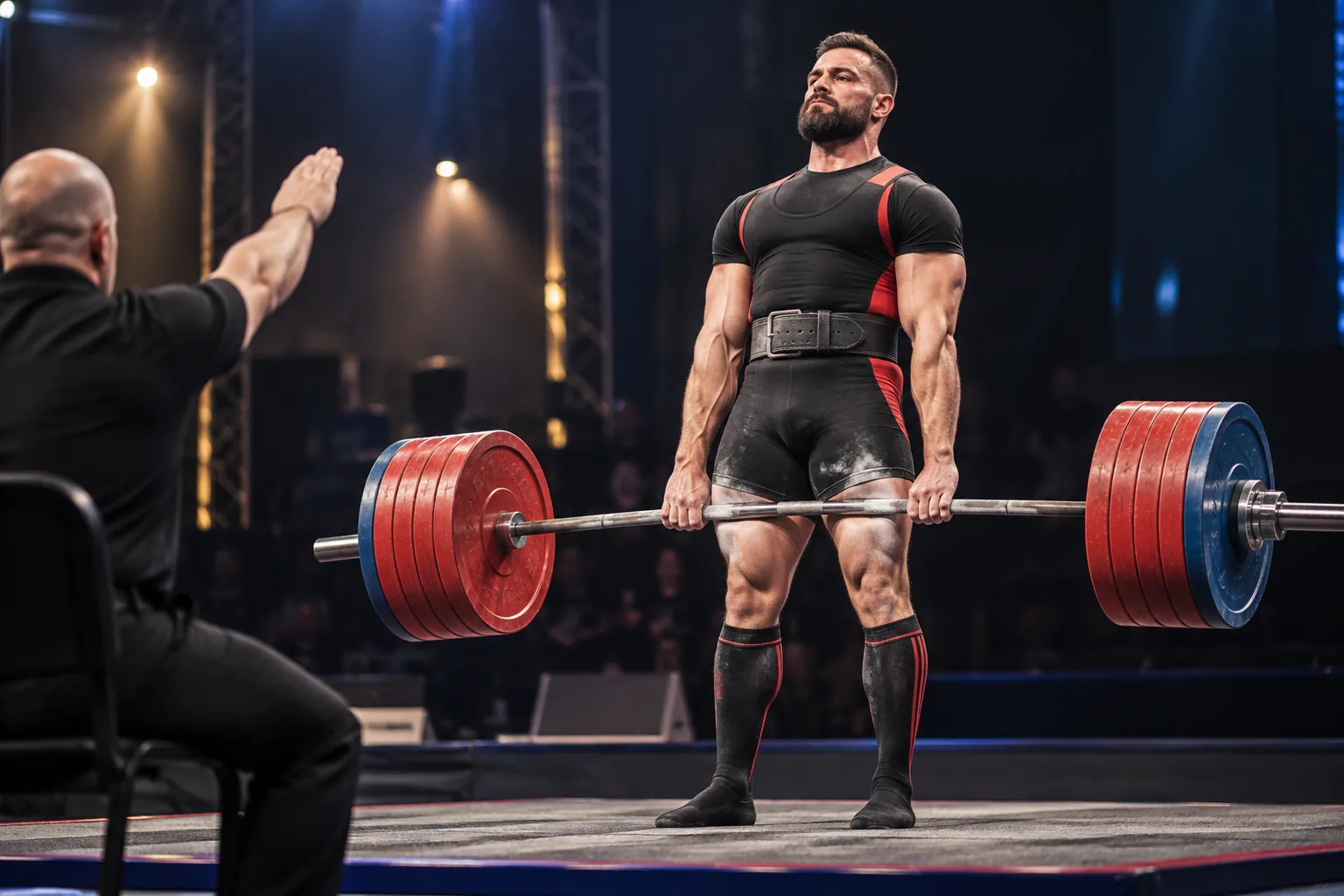
Powerlifting deadlift rules cover more than getting the bar off the floor. You must finish in the required position, wait for the referee’s DOWN command and return the bar under control. This guide explains the common faults and compares IPF, USA Powerlifting, WUAP and WPC rules.
Short answer: what makes a legal deadlift?
Stand facing the front of the platform, raise the bar with both hands, and finish upright with knees straight and shoulders in the position your federation requires. Hold the finished position without lowering the bar until the chief referee signals DOWN. Return the bar to the floor under control, retaining your grip. An early drop, failure to lock out, genuine downward motion before completion, or support of the bar on the thighs can result in red lights.
Unlike the squat or bench press, a standard powerlifting deadlift has no start command in the cited IPF and USA Powerlifting rulebooks. You begin when ready; the referee's signal comes at the finish.
Important: A stalled bar is not automatically a failed lift. A downward-moving bar and a bar paused in place are not the same thing. Nor does every contact between thighs and bar constitute hitching: the crucial distinction is supporting the bar on the thighs.
Deadlift Rule Checker
Educational summary, not an official ruling. Always verify the current federation rulebook and meet briefing.
Self-check before your next attempt
Checklist: 0 of 6 marked.
Deadlift DOWN Command Trainer
Simulated command timing is randomized for practice. It is not an official hold-time standard. Have a partner operate this tool when holding a bar; never interact with a screen under a loaded bar.
READY — begin when ready (no start command)
Training cue only: complete lockout first, hold position, then wait for DOWN.
This interactive tool helps you review federation-specific rules and practice the DOWN command. It is an educational aid, not an automated referee or video-judging service.
Select IPF, USA Powerlifting, WUAP, or WPC, then review each condition and open the appropriate official rulebook. The safest preparation is to confirm the rules used by the specific competition.
Deadlift rules step by step
- Set up: face forward with the bar in front of your feet. Select a permitted two-hand grip and stance. Sumo and conventional are generally both permitted in the cited rules; no special sumo exemption overrides lockout or foot-movement requirements.
- Begin on your own: there is no start command in the cited IPF or USA Powerlifting deadlift sections. A genuine effort to raise the bar counts as an attempt.
- Raise the bar: the bar may slow or stop, but an actual downward movement before the finished position can invalidate an attempt. Confirm precise movement wording in your federation.
- Stand erect: lock your knees and achieve the required shoulder/torso finish without supporting the load on the thighs.
- Wait: hold the bar motionless in the apparent finished position until the head referee gives DOWN (voice and arm movement).
- Lower with control: don't drop or release the bar. Maintain control with both hands as stipulated by the applicable federation.
WUAP-specific meet-day details (2026 v3.5)
WUAP counts the deadlift attempt as started once all plates have left the floor. Rolling the bar into the lift without the rulebook's brief visible stop is not permitted. From the 'bar ready' announcement the athlete has one minute to begin, and after a completed attempt 30 seconds to leave the platform. Section 6.3 also lists jerking the bar upward during the attempt as a disqualifying fault. For deadlift, WUAP requires socks covering the shins to just below the knees; RAW competitors may not use knee wraps or sleeves during the deadlift. These are WUAP-specific details, not rules to extrapolate to all federations.
Lockout and hitching
Knee lockout and shoulders
An athlete can straighten the knees while still not standing erect. Similarly, leaning back dramatically does not substitute for an accepted final position. The IPF 2026 book describes the shoulder finish in terms of the front deltoid relative to the bar's vertical projection and illustrates it. Use that published illustration when explaining marginal cases. Aim for the final position shown in your federation’s rulebook; exaggerating the lean-back is not a substitute for correct knee and shoulder position.
Hitching vs brushing the thighs
Hitching generally involves adopting a position that uses the thighs to support the bar. Brushing or sliding the bar against the thighs is not automatically the same thing. The IPF technical rules explicitly distinguish supported from unsupported thigh contact.
Example A: the bar grazes the thigh on the way up without resting on it: not automatically a hitch.
Example B: the lifter bends knees or leans backward to hold the bar's weight on the thighs and work it higher: can be disqualifying support.
DOWN command
The signal comes when the head referee judges that the bar is motionless and the apparent finish has been reached. Do not pre-empt it. A slow signal is not necessarily a rulebook-defined number of seconds: the timing depends on the visible finished position and the referee.
Federation comparison
On a small screen, scroll the comparison table sideways. Each column refers to the rulebook edition named below.
| Question | IPF (2026 v3) | USA Powerlifting (2026.2) | WUAP (2026 v3.5) | WPC (2025 official update) |
|---|---|---|---|---|
| Start signal? | No | No | No, explicitly stated in 6.3 | No |
| Finish command? | DOWN | DOWN | Audible DOWN / DOLE with downward arm signal | DOWN |
| Knee lockout? | Required | Required | Required (6.3) | Required |
| Erect finish? | Required, defined shoulder finish | Required, shoulders back | Required (6.3) | Required |
| Hitching / thigh support? | Prohibited | Prohibited | Prohibited (6.3) | Prohibited |
| Early downward movement? | Disqualifying before finish, subject to published shoulder-settling clarification | Disqualifying, with published shoulder-settling clarification | Disqualifying before finished position (6.3) | Disqualifying |
| Early lowering before DOWN? | Disqualifying | Disqualifying | Disqualifying (6.3) | Disqualifying |
| Sumo vs conventional | Both generally permitted | Both generally permitted | No stance-specific prohibition stated in 6.3; confirm event guidance | Verify local meet instructions |
This table is a reader-friendly comparison, not a legal interpretation. The supplied WUAP v3.5 rules (effective 1 March 2026) explicitly confirm no start command, a controlled stationary lockout and audible DOWN / DOLE with the referee's downward arm signal; both hands must remain on the bar until all plates rest on the platform. They prohibit downward movement before the finished position, incomplete knee lockout, bar support on thighs, stepping/stumbling, early lowering, dropping without both-hand control, and jerking the bar upward during the attempt. Additionally, WUAP requires a visible brief stop before starting a rolling deadlift, and gives the athlete one minute from 'bar is ready' to start. Unlike the generic table, WUAP's equipment rules require shin-covering socks below the knees; knee wraps/sleeves are prohibited for RAW deadlifts, while certain wraps are permitted in EQ (section 5.7 and 5.10). The WPC comparison draws from the accessible 2025 updated official rulebook; check event-specific instructions.
Why you got red lights
The following are common scenarios, not diagnoses of a particular attempt:
- Soft knees: one or both knees never reach full extension.
- Not upright: the lift stops before an accepted finished position, or shoulders don't satisfy the applicable rules.
- Bar reverses downward: the bar descends before the finish; a pause alone is not the same fault.
- Thigh support / hitching: the bar is supported on the thighs rather than just brushing them.
- Footwork: a step or stumble during the lift, where prohibited by the rulebook.
- Early return: lowering before the head referee's DOWN signal.
- Dropping: releasing the bar instead of controlling the descent.
- Other rule breaches: grip aid, equipment or platform issues may differ by federation and category.
Five-point competition checklist
- Know your federation and current rule edition.
- Check your grip, belt, socks, footwear and any restricted equipment at the meet.
- Lock the knees and stand erect; don't over-lean to manufacture a finish.
- Pause at lockout and wait for DOWN.
- Lower the bar with both hands under control.
Frequently asked questions
Is there a start command in a deadlift?
Not in the cited IPF or USA Powerlifting technical rules. Begin once ready. Check the event briefing.
Can I use sumo deadlift at a powerlifting meet?
In mainstream powerlifting rules referenced here, sumo and conventional are permitted. Check the federation, event and division rather than treating one ruleset as universal.
Is touching the bar to my thighs hitching?
No, not automatically. The important distinction is whether the bar is supported by the thighs during the lift.
Does a bar that stops moving get red lights?
A pause is not automatically a downward movement. The decisive issue is actual downward travel or another prohibited fault.
Should I wait one or three seconds at lockout?
There is no universal fixed lockout hold duration in the cited rules. Wait for the referee's DOWN command; don't guess a countdown.
Can I use straps?
For standard competitive deadlift attempts under the IPF framework, lifting straps are not permitted. Equipment rules vary by federation/division; consult the actual meet rules rather than relying on generic gym advice.
Is the DOWN command optional if the bar is locked out?
No. Lowering early can invalidate a technically completed lift.
Can an app or photograph declare my lift legal?
No. A single photo cannot establish the timing of commands, bar travel, thigh support or all angles needed for judging. The interactive companion is a checklist and command-practice tool, not a virtual referee.
Official rulebooks and sources
- IPF Technical Rulebook 2026 v3
- USA Powerlifting Rulebook v2026.2
- WUAP Rules 2026 v3.5
- WPC 2025 rulebook