Meet day is your chance to show the strength you already built.
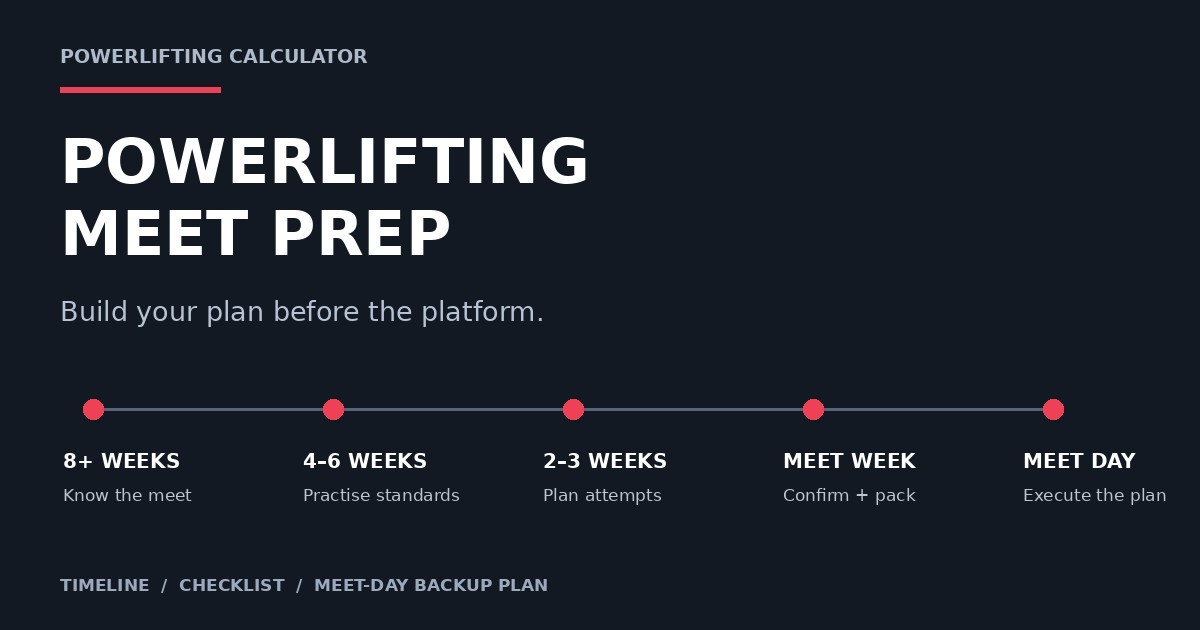
Good powerlifting meet prep is mostly about removing avoidable problems before they reach the platform: unclear commands, rushed warm-ups, aggressive openers, forgotten equipment, last-minute weight decisions and a meet-day plan that exists only in your head.
This guide gives you a practical countdown from the final weeks of training to your last deadlift attempt. It does not prescribe one universal powerlifting program. Instead, it focuses on the decisions that make a meet easier to execute: rules, equipment, competition-standard lifts, bodyweight, attempts, warm-ups, travel and timing.
Meet in less than a week? Jump to the meet-week checklist or the 48-hour final check.
Meet Prep Progress Tracker
Add your meet date and tick off the preparation steps as you complete them. Mark an item complete when it is done or you have confirmed it does not apply to your event.
Saved only in this browser. No account required; your checklist is not sent to our server.
Add your meet date to highlight the most relevant planning section.
8+ Weeks Out · Know the MeetMost relevant planning section right now
4–6 Weeks Out · Practise Competition StandardsMost relevant planning section right now
2–3 Weeks Out · Build the PlanMost relevant planning section right now
Meet Week · Reduce UncertaintyMost relevant planning section right now
Day Before · Make Tomorrow BoringMost relevant planning section right now
Meet Day · Execute the PlanMost relevant planning section right now
After the Meet · ReviewMost relevant planning section right now
Follow your current event rules and established coaching plan. Checklist completion does not predict your result.
Powerlifting Meet Prep at a Glance
Use the timeline as a checklist, not as a rigid program. Your coach, training history, federation and competition schedule may change the details.
| When | Main job | What should be decided |
|---|---|---|
| 8+ weeks out | Know the meet | Federation, date, division, weight class, travel |
| 4–6 weeks out | Make training competition-specific | Commands, depth, pause, equipment, rack setup |
| 2–3 weeks out | Build the meet-day plan | Likely opener range, warm-up outline, packing list |
| Meet week | Reduce uncertainty | Final schedule, taper, equipment, bodyweight decision |
| Day before | Make tomorrow boring | Pack, confirm times, charge devices, write down the plan |
| Meet day | Execute one decision at a time | Weigh-in, warm-ups, attempts, commands, recovery between lifts |
The key idea is simple: meet prep should move decisions out of meet day and into the weeks before it.
What Powerlifting Meet Prep Actually Means
Powerlifting preparation is broader than peaking strength.
You need to arrive with enough physical readiness to lift well, but also with a process that survives a long day, unfamiliar equipment, referee commands, changing flight times and the pressure of nine attempts.
A useful meet-prep plan covers five areas:
- Rules and eligibility — what your federation and event actually require.
- Competition skill — squat depth, bench commands, deadlift control and legal equipment.
- Performance planning — taper, likely attempts and warm-up structure.
- Logistics — travel, check-in, weigh-in, food, equipment and timing.
- Decision-making — what you will do when an attempt feels better or worse than expected.
Strength matters. Preparation makes that strength easier to display.
8+ Weeks Out: Know the Meet Before You Train for It
The first job is not to pick your opener. It is to understand the competition you entered.
Confirm:
- federation and current rulebook,
- meet date and venue,
- full power vs single-lift event,
- raw/classic vs equipped division,
- age and bodyweight division,
- registration and membership requirements,
- weigh-in time and format,
- equipment approval requirements,
- travel and accommodation,
- start time and session information when available.
If you have not chosen a competition yet, use the Powerlifting Competition Calendar to build a shortlist, then verify the organiser's official source before paying or booking travel. The separate How to Choose a Powerlifting Meet guide covers that decision in more detail.
Read the rulebook earlier than feels necessary
Do not wait until meet week to discover that your normal gym setup is not legal in your federation.
Rules can differ across federations in areas such as:
- commands,
- squat depth wording,
- bench setup,
- approved equipment,
- footwear,
- socks and singlets,
- weigh-in procedure,
- attempt changes,
- timing and cards.
For example, current IPF and USA Powerlifting rules both define detailed competition and weigh-in procedures, but you should never assume that rules transfer automatically to another federation or national affiliate.
Treat the rulebook and organiser instructions as the authority. This article is a planning guide around those rules.
4–6 Weeks Out: Make Training Look More Like Competition
The closer you get to the meet, the less useful it is to perform lifts that would not count on the platform.
You do not need every session to become a mock meet. You do want your competition lifts to feel familiar under competition standards.
Practise commands
A legal lift is not only about moving the bar.
Practise waiting for the commands used by your federation. If you have a training partner or coach, let them call commands. If you train alone, use recorded commands or deliberately pause at the required decision points.
For bench press, use the Powerlifting Bench Press Rules & Command Trainer to compare federation differences and practise the actual command sequence.
Make squat depth repeatable
Do not aim to discover your legal depth on the platform.
Film working sets from a useful side angle and review the relevant hip/knee landmarks. The goal is not to squat dramatically deeper than necessary. It is to make legal depth repeatable without losing balance, brace or bar path.
Use the Powerlifting Squat Depth Guide and Checker for a visual review. It is a training aid, not an official referee decision.
Use the equipment you will actually compete in
Meet week is a poor time to discover that your singlet rubs, your belt setting feels wrong or your shoes change your setup.
Train enough with your planned:
- belt,
- knee sleeves or wraps where permitted,
- wrist wraps,
- shoes,
- singlet,
- bench shirt/equipped gear where applicable,
to know how they affect your setup.
Check approved-equipment requirements if your federation uses them.
Record rack and bench settings
If the event uses adjustable racks, record the settings you use in training when possible.
A simple note can prevent unnecessary guesswork:
- squat rack height,
- squat safety height where relevant,
- bench rack height,
- preferred handoff notes.
The exact system depends on the meet equipment, so treat these as starting references rather than guarantees.
2–3 Weeks Out: Build Your Attempt Plan
You do not need to lock all nine attempts weeks in advance. You should have a decision framework before meet day.
The opener should be supported by recent training evidence and should be a lift you expect to complete to competition standard even when the environment is unfamiliar.
The second attempt should build the total without removing your options.
The third attempt should respond to what the second attempt actually told you.
For the full decision framework, use:
Do not turn percentages into promises
A percentage can be useful as a planning reference, but it cannot know:
- how you slept,
- how the weight cut affected you,
- whether your warm-ups were rushed,
- whether the first attempt was technically clean,
- how the judges are calling the lift,
- how the bar moved today.
Write tentative attempts, then write the condition that would justify changing them.
For example:
If the opener is technically clean and clearly submaximal, take the planned second. If it is slower than expected or receives a technical red light, adjust the second before thinking about a PR.
That is more useful than arriving with three numbers you refuse to change.
What Real Competition Data Says About Attempt Success
Attempt numbers have different jobs, and competition data reflects that.
The chart below uses Powerlifting Calculator's OpenPowerlifting analysis to show the observed make rate for first, second and third attempts across squat, bench press and deadlift.
Attempt Success by Attempt Number
Squat
Bench Press
Deadlift
| Lift | Attempt | Recorded | Successful | Failed | Success rate |
|---|---|---|---|---|---|
| Squat | 1 | 343,404 | 303,575 | 39,829 | 88.4% |
| Squat | 2 | 341,445 | 286,764 | 54,681 | 84.0% |
| Squat | 3 | 336,962 | 225,192 | 111,770 | 66.8% |
| Bench Press | 1 | 342,732 | 314,205 | 28,527 | 91.7% |
| Bench Press | 2 | 340,779 | 277,200 | 63,579 | 81.3% |
| Bench Press | 3 | 335,416 | 165,375 | 170,041 | 49.3% |
| Deadlift | 1 | 341,776 | 324,688 | 17,088 | 95.0% |
| Deadlift | 2 | 338,622 | 299,753 | 38,869 | 88.5% |
| Deadlift | 3 | 333,311 | 203,878 | 129,433 | 61.2% |
Data source: OpenPowerlifting. Analysis generated by Powerlifting Calculator.
Use this as context, not as a formula for your own attempt percentages.
A first attempt is normally selected to establish a successful lift and get the lifter on the board. A third attempt is more often where lifters chase a personal record, placing, qualifying total, federation record or the highest total available on the day.
That difference in purpose matters when reading the chart. A lower observed success rate on later attempts would not automatically mean those attempts were badly chosen. More aggressive attempt selection can be intentional.
The data also keeps squat, bench press and deadlift separate because the lifts happen at different points in the meet and carry different technical and fatigue demands.
For methodology, limitations and the full analysis, read How Often Do Powerlifters Make Each Attempt?.
The chart updates with the analysis pipeline. Its percentages describe recorded attempts in the dataset; they are not your personal odds of success.
Weight Class and Weigh-In: Decide Early, Not in Panic Mode
Your weight class affects preparation, but being close to a lower class does not automatically mean you should cut.
Start by confirming:
- your federation's actual classes,
- your registered/nominated class,
- your normal morning bodyweight trend,
- the weigh-in window,
- whether class changes are permitted,
- what matters most at this meet.
Use the Powerlifting Weight Class Guide and Weight Class Checker to understand the category structure.
If you are considering a lower class, the Powerlifting Weight Cut Calculator and Weight-Class Decision Guide can help frame the arithmetic.
They deliberately do not provide dehydration, sauna, sodium-restriction or water-loading protocols.
Why the weigh-in window matters
Recovery time after weighing in differs by federation and event.
Check the scheduled start and end of weigh-in and the start of lifting in your event information. Read your federation's current rules rather than assuming another meet's recovery window applies.
That difference matters because a bodyweight strategy that looks manageable with a long recovery period may create a completely different competition-day problem with a short recovery window.
For a first meet, reducing unnecessary variables is often more valuable than forcing a lower bodyweight class.
Tapering: Remove Fatigue Without Inventing a New Program
The final phase before competition is not the time to build new strength.
A taper generally reduces training stress so the athlete can express existing fitness with less accumulated fatigue. Research specific to powerlifting is more limited than the endurance-sport literature, and reviews of strength-sport tapering do not support one universal protocol that fits every lifter.
That is important.
Do not copy a stranger's exact final-week percentages simply because they worked for that lifter.
A sensible taper should be based on:
- your normal training structure,
- how much fatigue you accumulate,
- how you respond to reduced volume,
- your coach's plan,
- the timing of your final heavy exposures,
- and your competition date.
The practical meet-prep rule is simpler:
Do not try to cram fitness into the final week.
Avoid turning nerves into extra max attempts, extra volume or unfamiliar conditioning. The goal is to arrive ready to perform the lifts you already prepared.
The 2020 powerlifting taper review describes the limited strength-sport evidence. Use it as background for an established coaching plan, rather than as a universal final-week schedule.
Meet Week: Reduce Uncertainty, Not Just Training
By meet week, the major decisions should already exist.
Your job is to confirm them.
Meet-week checklist
- Re-read the event email and current schedule.
- Confirm the venue and parking/travel route.
- Confirm weigh-in and lifting times.
- Check membership/ID requirements.
- Confirm your equipment.
- Review commands.
- Confirm your bodyweight plan.
- Write down tentative openers.
- Write down a warm-up outline.
- Charge your phone and any headphones/device you rely on.
- Decide what food and fluids you will bring.
- Know who will handle you, if anyone.
- Know how you will record or review attempts if you want video.
Do not introduce avoidable novelty.
That means meet week is usually a poor time for:
- new shoes,
- a new belt setting,
- a new pre-workout,
- a new food strategy,
- a new warm-up sequence,
- a last-minute technique overhaul,
- an unplanned max attempt.
Familiar and boring is useful.
What to Pack for a Powerlifting Meet
Your exact list depends on federation rules and personal preferences, but the categories are predictable.
Competition equipment
- singlet,
- approved shirt where required,
- socks,
- lifting shoes,
- belt,
- wrist wraps,
- knee sleeves/wraps where applicable,
- deadlift socks where required,
- underwear that complies with the rules,
- any approved equipped lifting gear.
Documents and meet information
- photo ID,
- membership information,
- entry confirmation,
- event schedule,
- rulebook link or saved reference,
- rack settings if known,
- written attempt/warm-up plan.
Long-day essentials
- normal food you already tolerate,
- drinks,
- basic hygiene items,
- layers/comfortable clothing between lifts,
- phone charger/power bank,
- small bag for platform equipment,
- anything your organiser specifically requires.
For a printable version, use the free First Powerlifting Meet Checklist. It includes packing lists, a warm-up worksheet and a nine-attempt meet card.
Plan Your Warm-Ups Before You Arrive
Warm-ups should prepare you for the opener without becoming another workout.
There is no universal percentage ladder or exact clock that works at every meet because the timing depends on:
- flight size,
- lifter order,
- loading speed,
- equipment availability,
- how many warm-up stations exist,
- whether the schedule is ahead or behind,
- your normal warm-up needs.
Build the warm-up backward
A useful planning process is:
- Know the opener.
- Know the last warm-up you normally need before that opener.
- Estimate how long you want between your last warm-up and the platform.
- Work backward through the previous warm-ups.
- Adjust to the real flight, not only the printed schedule.
Your warm-up plan should include fewer decisions, not more complexity.
A written plan might have:
- exercise,
- load,
- approximate order,
- optional small adjustment,
- last warm-up target.
If the room is chaotic, ask your handler, coach or an experienced meet official for timing context rather than blindly following the clock.
The First Powerlifting Meet Guide explains the broader competition flow, while the free checklist and paid Playbook provide dedicated warm-up worksheets.
Warm-Up Room Etiquette: Make the Room Easier for Everyone
The warm-up room is shared space, not a private training station.
A few habits make the entire flight run more smoothly:
- Share racks and platforms instead of treating one station as yours.
- Tell the group what weight you need next so loading can be coordinated.
- Help load and unload when practical.
- Keep bags, plates and loose equipment out of walkways.
- Know roughly where your flight is in the running order.
- Avoid turning warm-ups into extra max attempts that slow everyone down.
- Ask before changing a rack setting that another lifter is actively using.
Good warm-up-room etiquette is not complicated. Communicate, share equipment and remember that everyone else is trying to time a competition warm-up too.
Day Before the Meet: Make Tomorrow Boring
The day before the meet is mostly an organisation day.
Do the things that make it difficult to forget something when you are tired or nervous.
Final day-before tasks
- Pack the complete bag.
- Put documents/ID where you cannot forget them.
- Confirm travel time.
- Set alarms.
- Check the latest organiser message.
- Review the federation commands once.
- Confirm tentative openers and warm-ups.
- Confirm your bodyweight situation without panic.
- Eat and drink according to a familiar plan.
- Avoid turning "feeling good" into a surprise max-out.
If you are travelling, build in more time than a normal commute. Arriving rushed is an avoidable stressor.
Meet Day: From Weigh-In to Final Deadlift
The exact administration order varies, but a full-power meet usually follows the same broad arc:
- Arrival / check-in
- Equipment or rack-setting procedures where applicable
- Weigh-in
- Recovery / preparation
- Squat warm-up
- Squat attempts
- Bench warm-up
- Bench attempts
- Deadlift warm-up
- Deadlift attempts
- Final total and post-meet review
Follow the organiser's real schedule and announcements rather than forcing this sequence onto every federation.
Treat the meet as nine separate decisions
Do not carry the third deadlift in your head while you are waiting for the squat command.
On each attempt:
- Know the weight.
- Know the command/cue.
- Complete the attempt.
- Read the result and lights.
- Decide the next attempt.
- Then move on.
This protects you from letting one mistake infect the rest of the day.
If You Do Not Have a Handler
Many lifters compete without a coach or dedicated handler. That does not mean the meet has to feel chaotic, but your system should become simpler, not more complicated.
If you are handling yourself:
- Keep your tentative attempts and warm-ups written down somewhere you can access quickly.
- Know where the running order or flight information is displayed.
- Ask an official or experienced lifter if you are unsure how quickly the flight is moving.
- Keep track of when your next attempt must be submitted according to the rules of your federation.
- After each attempt, check the result/lights before deciding the next weight.
- Keep your platform equipment together in one small, easy-to-grab bag.
- Do not rely on your phone as the only copy of the plan; battery, signal and distractions are avoidable failure points.
Solo meet-day rule: If nobody is managing the day for you, make the plan simpler — not more detailed.
Your Nine Attempts Need a Plan — and a Backup Plan
A meet plan should be conditional.
For each lift, write:
- tentative opener,
- tentative second,
- tentative third range,
- what earns the bigger third,
- what you do after a technical miss,
- what you do after a strength miss.
If the opener goes well
A clean, confident opener gives you options.
Do not automatically turn that into the largest possible jump. Use the second attempt to build the total and gather another piece of evidence about readiness.
If the opener is slower than expected
A slow opener does not automatically mean disaster.
Check:
- Was the lift technically clean?
- Was it a timing/command issue?
- Was the warm-up rushed?
- Was the weight simply heavier than expected?
Then adjust.
If you miss an attempt
Separate why you missed from how much you missed.
A technical red light on a weight you were strong enough to lift is a different problem from a bar that stopped.
Do not make the next call only from emotion.
For deeper examples, use the Attempt Selection Guide.
When the Plan Breaks: Meet-Day Contingencies
A good plan is useful. A good plan with simple backup decisions is better.
Meet day can run late, speed up unexpectedly, crowd the warm-up room or expose a technical problem you did not expect. The goal is not to predict every problem. It is to avoid making a small disruption worse.
| Situation | First response | What not to do |
|---|---|---|
| Meet is running 20–30 minutes late | Slow the warm-up progression, stay warm and keep the final warm-ups aligned with the real flight | Keep taking extra heavy warm-ups just to fill time |
| Flight is moving faster than expected | Compress the early warm-ups and protect the most important final warm-up | Panic and jump straight to a near-opener without context |
| Opener gets red lights for a command/technical issue | Identify the technical reason first and correct it on the next attempt | Add weight automatically because the bar felt easy |
| Opener is much slower than expected | Reduce the planned second-attempt jump and preserve the total | Chase the pre-written second attempt at all costs |
| Warm-up room is crowded | Communicate, share racks and coordinate loading with the group | Wait silently until your timing is already lost |
| Equipment or rack-setting issue appears | Tell the handler or meet official early and use the event's proper procedure | Improvise a platform solution at the last second |
| Bodyweight is not where expected | Follow the event/federation procedure and protect performance | Start an emergency dehydration or weight-loss experiment |
| A previous attempt went badly | Separate the technical/strength problem, make the next decision, then move on | Let one miss change every remaining decision emotionally |
The common theme is protect the next useful decision.
Do not solve a timing problem with extra fatigue. Do not solve a technical problem by automatically adding weight. Do not solve a bodyweight surprise with an unplanned acute cut.
If the event's rules or officials require a different procedure, the official procedure wins.
Common Powerlifting Meet-Prep Mistakes
1. Treating the opener like a test of strength
The opener's job is to start the meet with a successful competition-standard lift and useful information.
An opener that already requires a perfect day leaves little room for the rest of the attempt plan.
2. Practising commands for the first time on meet day
A lift can be physically strong and still receive red lights for a command or technical error.
Make commands boring in training.
3. Discovering your federation's rules too late
Rules around equipment, bench setup, depth and weigh-in are not universal.
Read the current rulebook before the final week.
4. Making a last-minute weight-class decision
Bodyweight panic competes with performance preparation for attention.
Decide early enough to avoid turning meet week into an emergency.
5. Using a warm-up plan that ignores the flight
A perfect spreadsheet is useless if the flight moves faster or slower than expected.
Plan the structure, then adapt to the room.
6. Trying new equipment, food or supplements
Meet day is already full of variables.
Do not add avoidable ones.
7. Having numbers but no decision rules
Three written attempts are not a strategy if you do not know what would make you change them.
Write the "if this, then that" decisions before the meet.
8. Forgetting the meet continues after a mistake
One miss does not define the day unless you let it.
Reset the next decision.
48-Hour Powerlifting Meet Prep Check
Use this as the final quick review.
Rules and logistics
- I know the current meet schedule.
- I know the weigh-in time and location.
- I have the required ID/membership information.
- I know my federation's commands.
- I know how I am getting to the venue.
Equipment
- Singlet and required clothing packed.
- Shoes packed.
- Belt/wraps/sleeves packed where applicable.
- Backup small items packed where useful.
- Rack settings written down if known.
Performance plan
- Tentative squat opener written.
- Tentative bench opener written.
- Tentative deadlift opener written.
- Warm-up outline written for all three lifts.
- I know what would make me change a second or third attempt.
Meet-day basics
- Familiar food/drinks packed.
- Phone charged.
- Charger/power bank packed.
- Travel alarm set.
- I am not relying on memory for the important parts of the plan.
If you want the printable version, download the Free First Powerlifting Meet Checklist.
After the Meet: Review Before You Forget
Meet prep does not end with the final deadlift.
The competition gives you information that a normal training day cannot.
Within a day or two, record:
- all nine attempts,
- white/red light patterns,
- command mistakes,
- how warm-ups felt,
- whether timing worked,
- whether the opener choices were right,
- what changed after the second attempts,
- how equipment felt,
- how bodyweight/weigh-in affected the day,
- the one or two priorities for the next meet.
Do not reduce the review to "PR or no PR."
A meet where you learn how to handle commands, warm-ups and attempt calls can improve the next competition even if the total was not what you wanted.
The paid Powerlifting Meet Day Playbook includes reusable preparation, warm-up, attempt and post-meet review worksheets for lifters who want the full written system.
Powerlifting Meet Prep FAQ
How far out should I start preparing for a powerlifting meet?
Meet preparation starts as soon as the event is chosen because federation rules, travel, bodyweight class and competition standards can affect training decisions. This guide uses an 8+ week planning window as an organisational framework, not as a universal training program.
What should I do the week before a powerlifting meet?
Use meet week to reduce uncertainty. Confirm the schedule, rules, equipment, bodyweight plan, openers, warm-ups, travel and packing. Follow your established taper rather than adding unplanned heavy work or new routines.
Should I max out before a powerlifting meet?
A last-minute max is usually poor meet preparation because it adds fatigue and risk without building meaningful new strength before competition. Follow your established training/taper plan instead of testing fitness simply because the meet is close.
How should I choose my opening attempts?
Base openers on recent successful competition-standard training, not on the biggest number you hope to lift. The opener should give you a high-confidence start and useful information for the second attempt. Use the Powerlifting Attempt Selection guide and Attempt Planner for the full framework.
Should I cut weight for my first powerlifting meet?
A weight cut is not required. For many first-time lifters, competing near normal bodyweight removes an extra variable while they learn commands, timing and attempt selection. If you are considering a lower class, verify the federation's weigh-in rules and use appropriate professional guidance rather than following an acute dehydration protocol online.
What should I bring to a powerlifting meet?
Bring the competition clothing and equipment required by your federation, ID/membership documents, your written attempt and warm-up plan, familiar food/drinks and normal long-day essentials. Use the free printable First Powerlifting Meet Checklist for a detailed packing list.
How do I practise powerlifting commands?
Use the commands required by your federation during competition-style training reps. A coach or training partner can call them, and the Bench Press Command Trainer can help practise bench timing. Always check the current federation rulebook because commands and technical rules can differ.
How do I know when to start warming up?
Work backward from your opener and expected flight position using your normal warm-up needs. The exact timing depends on flight size and meet pace, so adapt to the real room rather than relying on one fixed minute-by-minute schedule.
Your Meet Prep Plan
Good meet prep does not guarantee nine successful attempts.
It does something more useful: it removes problems that did not need to exist.
Know the rules. Practise the competition version of the lifts. Decide your bodyweight strategy early. Write down attempts and warm-ups. Pack before you are tired. Then let meet day be a sequence of simple decisions instead of a pile of surprises.
Use these tools next
- Powerlifting Attempt Selection
- Powerlifting Attempt Planner
- Powerlifting Bench Press Rules & Command Trainer
- Powerlifting Squat Depth Guide
- Powerlifting Weight Cut Calculator
- Powerlifting Weight Classes Explained
- First Powerlifting Meet Guide
- Free First Powerlifting Meet Checklist
- Powerlifting Meet Day Playbook
- Find a Powerlifting Competition
Sources and Review
Prepared by Powerlifting Calculator. Sources and links checked on 11 October 2026.
- IPF current Technical Rules — version effective 1 March 2026 listed when checked.
- USA Powerlifting current rulebook — v2026.2 listed when checked.
- Travis et al. (2020): Tapering and Peaking Maximal Strength for Powerlifting Performance — review of the available evidence.
- OpenPowerlifting attempt-success analysis and methodology — dataset context for the live chart.