Powerlifting weight classes group lifters by bodyweight so athletes of broadly similar size can compete within the same category. But understanding your weight class involves more than simply stepping on a scale.
Different federations can use different weight classes, age divisions may affect the available categories, and being close to a class boundary does not automatically mean you should try to lose weight before a competition.
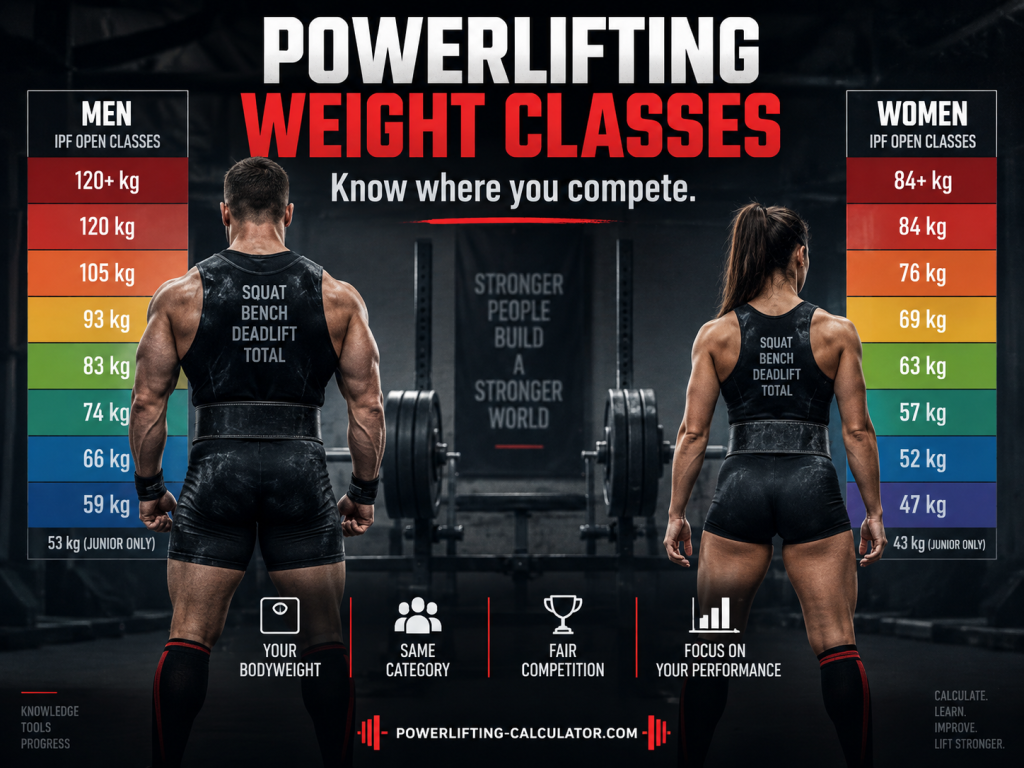
This guide explains how powerlifting weight classes work, shows the current IPF men's and women's Open weight classes, explains what happens at class boundaries, and helps you understand what to check before entering a meet.
Your powerlifting weight class is determined by your official bodyweight at weigh-in and the class limits used by your federation and competition. A lifter weighing 82.9 kg in an IPF men's Open competition, for example, falls within the 83 kg class.
What Are Powerlifting Weight Classes?
Powerlifting competitions include athletes with very different body sizes. Comparing every lifter only by the absolute amount of weight lifted would naturally favour larger athletes in many situations.
Weight classes divide competitors into bodyweight categories.
A lifter competes within the category that corresponds to their official weigh-in bodyweight under the rules of the competition.
This allows athletes of broadly similar bodyweight to compete for placings within the same category.
Weight classes should not be confused with bodyweight-adjusted scoring systems such as DOTS or IPF GL. They solve related but different problems.
- Weight classes divide lifters into competition categories.
- DOTS, Wilks and IPF GL mathematically adjust performances for bodyweight to help compare lifters of different sizes.
Current IPF Men's Weight Classes
Under the IPF Technical Rules effective from 1 March 2026, the men's bodyweight categories are:
| Class | Bodyweight Range |
|---|---|
| 59 kg | Up to 59.0 kg |
| 66 kg | 59.01–66.0 kg |
| 74 kg | 66.01–74.0 kg |
| 83 kg | 74.01–83.0 kg |
| 93 kg | 83.01–93.0 kg |
| 105 kg | 93.01–105.0 kg |
| 120 kg | 105.01–120.0 kg |
| 120+ kg | Above 120.0 kg |
The IPF also includes a 53 kg men's category for Sub-Junior and Junior lifters only. It is not an Open men's category.
Current IPF Women's Weight Classes
The current IPF women's bodyweight categories are:
| Class | Bodyweight Range |
|---|---|
| 47 kg | Up to 47.0 kg |
| 52 kg | 47.01–52.0 kg |
| 57 kg | 52.01–57.0 kg |
| 63 kg | 57.01–63.0 kg |
| 69 kg | 63.01–69.0 kg |
| 76 kg | 69.01–76.0 kg |
| 84 kg | 76.01–84.0 kg |
| 84+ kg | Above 84.0 kg |
The IPF also includes a 43 kg women's category for Sub-Junior and Junior lifters only.
These are IPF categories. Other powerlifting federations may use different class limits. Always check the current rulebook and entry information for your specific competition.
How Does a Weight Class Boundary Work?
A class name normally represents its upper bodyweight limit.
Consider the IPF men's 83 kg class.
| Weigh-In Bodyweight | IPF Men's Open Class |
|---|---|
| 82.5 kg | 83 kg |
| 82.9 kg | 83 kg |
| 83.0 kg | 83 kg |
| 83.1 kg | 93 kg |
At exactly 83.0 kg, the lifter is still within the 83 kg class. A bodyweight above that upper limit falls within the next class numerically, but moving to that class at the meet may not be permitted. IPF international nominations lock the weight category after final nomination; check your event rules rather than assuming you can switch classes at weigh-in.
The exact official weigh-in procedure, scale precision and eligibility rules are determined by the federation and competition, not by an online calculator.
Check Your Powerlifting Weight Class
Enter your bodyweight into our free Weight Class Checker to see where it falls within the stored federation presets and how close you are to the next boundary.
Always confirm your competition category with the current federation rulebook and meet organiser.
Do All Powerlifting Federations Use the Same Weight Classes?
No.
There is no single worldwide set of weight classes used by every powerlifting federation.
Different organisations can define different class boundaries, divisions and eligibility rules. National affiliates or individual events may also have requirements that need to be checked separately.
This means that saying:
"I am an 83 kg powerlifter"
only has a precise competition meaning when the federation and division are known.
Before entering a competition, confirm at least:
- the sanctioning federation,
- your sex category under the applicable rules,
- your age division,
- the available bodyweight classes,
- the event date and applicable rulebook version,
- and the organiser's entry requirements.
Weight Class vs Age Division: What's the Difference?
A weight class and an age division are not the same thing.
Your weight class groups you according to bodyweight.
Your age division groups you according to age under the rules of the federation.
For example, the current IPF rules recognise age categories including Sub-Junior, Junior, Open and several Masters divisions.
A lifter can therefore have both an age division and a weight class.
For example:
Junior – 74 kg class
or:
Open – 83 kg class
The combination identifies the competition category more precisely than bodyweight alone.
Which Powerlifting Weight Class Should You Compete In?
For many recreational and first-time competitors, the simplest answer is often to compete in the class that naturally corresponds to their normal bodyweight rather than assuming that they must lose weight to enter a lighter category.
Being close to a lower weight-class limit does not automatically mean that cutting weight will improve your competition result.
Your decision can depend on factors such as:
- your normal bodyweight,
- training performance,
- competition experience,
- how close you naturally are to a class boundary,
- your goals for the competition,
- the federation's weigh-in procedure,
- and professional coaching or medical guidance where appropriate.
For a first meet, learning the competition process and successfully putting lifts on the board may be more useful than adding an unnecessary bodyweight-management challenge.
Do You Need to Fill Out Your Weight Class?
No.
You do not need to weigh exactly the maximum allowed bodyweight for your class.
An 80 kg lifter competing in an IPF men's Open event falls within the 83 kg class. The lifter does not need to gain three kilograms simply because the category is called the "83 kg class."
The number is an upper boundary, not a target bodyweight.
This distinction is important because lifters sometimes assume that being lighter than the class limit means they are automatically competing incorrectly.
It does not.
Should You Cut Weight for a Powerlifting Meet?
A weight cut is not a requirement for competing in powerlifting.
Some experienced competitive lifters deliberately manage bodyweight to enter a particular category. That is a separate strategic decision from simply identifying which class their current bodyweight belongs to.
Rapid or aggressive bodyweight manipulation can affect hydration, recovery and performance and can carry health risks. The practical consequences also depend on the federation's weigh-in procedures and the time available before lifting.
For those reasons, an online weight-class calculator should not be interpreted as advice to lose weight.
"Distance to the class limit" is just arithmetic. It is not a recommendation to cut, gain or manipulate bodyweight.
Does Being Lighter in a Weight Class Matter?
Two lifters in the same class can have different bodyweights.
For example, one lifter in the 83 kg class might weigh 82.9 kg while another weighs 79.5 kg.
They are still competing in the same bodyweight category if both satisfy the applicable rules.
Within competition, the federation's rules determine how placings and any ties are resolved.
Under current IPF rules, if two lifters achieve the same total, the lighter lifter ranks ahead. If they record the same bodyweight and ultimately achieve the same total, the lifter who achieved the total first takes precedence.
This is a competition rule and should not be confused with DOTS or another bodyweight-adjusted scoring formula.
Weight Classes vs DOTS: What's the Difference?
Weight classes and DOTS both relate to bodyweight, but they are used differently.
| System | Purpose |
|---|---|
| Weight Class | Places a lifter into a competition bodyweight category. |
| DOTS | Produces a bodyweight-adjusted score that can help compare performances across different bodyweights. |
Imagine two lifters:
- Lifter A: 74 kg bodyweight, 550 kg total
- Lifter B: 93 kg bodyweight, 620 kg total
Their weight classes tell you where they compete.
Their totals tell you how much weight they lifted.
A scoring formula such as DOTS provides another way to compare the performances while accounting for bodyweight.
For a deeper explanation, see our guide to DOTS vs Wilks vs IPF GL.
What Happens at the Weigh-In?
Your competition bodyweight is established through the official weigh-in process defined by the federation and event.
This is the bodyweight used to determine whether you meet the requirements of the category in which you are competing.
The exact process can differ between organisations, so do not assume that the procedure from one federation automatically applies to another.
Before meet day, check:
- when weigh-in begins,
- how long the weigh-in period lasts,
- what identification or membership documents are required,
- the rules regarding clothing during weigh-in,
- your nominated bodyweight category,
- and what happens if your bodyweight does not meet the requirements of that category.
The meet information and current federation rulebook should be your authoritative sources.
Common Weight Class Mistakes
1. Treating the class limit as a target bodyweight
You do not need to weigh exactly 83 kg to compete in the 83 kg class.
2. Assuming every federation uses the same classes
A class used by one federation may not exist in another.
3. Ignoring age divisions
Some classes may only be available to particular age categories. The IPF's additional 53 kg men's and 43 kg women's categories, for example, apply to Junior and Sub-Junior lifters.
4. Using pounds as if they define separate official classes
When federation limits are defined in kilograms, a pound value is a conversion of that limit rather than a separate category system.
5. Automatically deciding to cut weight
A calculator showing that you are close to a lower class does not mean moving down is automatically the best choice.
6. Relying on an old chart
Federation rules can change. Always check the current rules applicable to your event.
How to Check Your Weight Class Before a Meet
A simple process can prevent most confusion:
- Identify your federation.
- Identify your age and competition division.
- Check the current official rulebook.
- Check your event's entry information.
- Compare your normal bodyweight with the applicable class limits.
- Confirm anything unclear with the meet organiser.
You can use our Powerlifting Weight Class Checker as a convenient reference, but official event rules always take precedence.
Preparing for Your First Powerlifting Meet?
Knowing your weight class is only one part of meet preparation.
Our free First Powerlifting Meet Checklist includes pre-meet preparation, a packing checklist, attempt planning pages, a warm-up worksheet and a printable meet card.
Powerlifting Weight Classes FAQ
What weight class am I in for powerlifting?
Your weight class depends on your official bodyweight and the class limits used by your federation, age division and competition. Use the current federation rulebook rather than assuming all organisations use the same categories.
What class is an 82 kg male powerlifter in?
Under the current IPF men's Open classes, an 82 kg lifter falls within the 83 kg category. Other federations may use different limits.
Can I weigh less than my powerlifting weight class?
Yes. A class number is normally its upper bodyweight limit, not the bodyweight every lifter must reach. For example, an 80 kg lifter can fall within an 83 kg category where those IPF limits apply.
What happens if I weigh exactly 83 kg?
Under the current IPF men's categories, 83.0 kg is within the 83 kg class. A bodyweight above that limit falls into the next applicable category.
Do all powerlifting federations have the same weight classes?
No. Weight classes and other competition categories can differ between federations. Always check the rules for your specific organisation and event.
Should I lose weight to enter a lower class?
Being close to a lower category does not automatically mean you should reduce bodyweight. Weight management is separate from identifying your class and can affect health and performance. Competition experience, normal bodyweight, weigh-in rules and appropriate professional guidance should all be considered.
Is weight class the same as DOTS?
No. A weight class determines your competition bodyweight category. DOTS is a mathematical scoring system designed to help compare powerlifting performances across different bodyweights.
Are there different weight classes for junior lifters?
There can be. Under current IPF rules, Sub-Junior and Junior competitors have an additional lowest category: up to 53 kg for men and up to 43 kg for women.
Find Your Class, Then Focus on Your Performance
Your weight class tells you where you compete. It does not define how strong you are and it is not a target bodyweight you must reach.
Start with your normal bodyweight, identify the correct federation and division, verify the current competition rules and use your class as one piece of the larger competition picture.
Once you know where you compete, the more useful questions become what you can successfully squat, bench press and deadlift — and how well you can put those lifts together on meet day.
Check your weight class →
Understand your powerlifting total →
Compare DOTS, Wilks and IPF GL →
Plan your competition attempts →
Explore more powerlifting guides →
Sources & Further Reading
International Powerlifting Federation – Technical Rules
International Powerlifting Federation – IPF GL Formula
Powerlifting-Calculator.com – Calculator Methodology
Last reviewed: September 2026. Federation rules and weight classes can change. Always confirm the rules applicable to your specific competition before entering a weight category.