A squat can feel deep, look convincing from the front and get a confident “good” from your training partners. Then meet day comes and the same movement gets red lights. Powerlifting squat depth depends on specific anatomical landmarks, rather than how hard the rep felt or how low the bar travelled.
This guide explains the reference points, shows high, borderline and clear depth, and gives you a practical way to review your own footage. The checker below compares points you select in an image; it cannot judge a competition attempt.
What Is Legal Squat Depth in Powerlifting?
The IPF describes the top surface of the legs at the hip joint descending lower than the top of the knees. USA Powerlifting is more anatomically explicit: its reference is the top/anterior surface at the hip joint, identified as the inguinal crease. The cited WPC document uses the top surface at the hip joint and the top of the knees. See the source versions and limitations below.
For a useful training review, identify the hip-side reference on the upper/front surface of the thigh where it meets the torso. Compare it with the top of the knee on the same visible side. Do not mark the centre of the hip joint, the lowest part of the buttocks, the middle of the kneecap, the belt, or an arbitrary fold in your shorts.
The practical target is for that hip-side reference to be visibly lower than the top of the knee. Not exactly level. Not “close enough to parallel.” Below. There is no universal centimetre or pixel allowance in these depth definitions.
Why “Parallel” Is a Misleading Term
“Parallel” is gym shorthand. One person means the femur looks horizontal; another watches the top of the thigh; a third watches its underside. Others mistake a forward-leaning torso for a deep squat. Those observations can describe different positions in the same rep.
When someone calls a powerlifting parallel squat “good,” ask which landmarks they compared. The question is not whether some part of the thigh looks horizontal. It is whether the rulebook's hip reference descended below the knee reference.
High vs Borderline vs Clear Depth
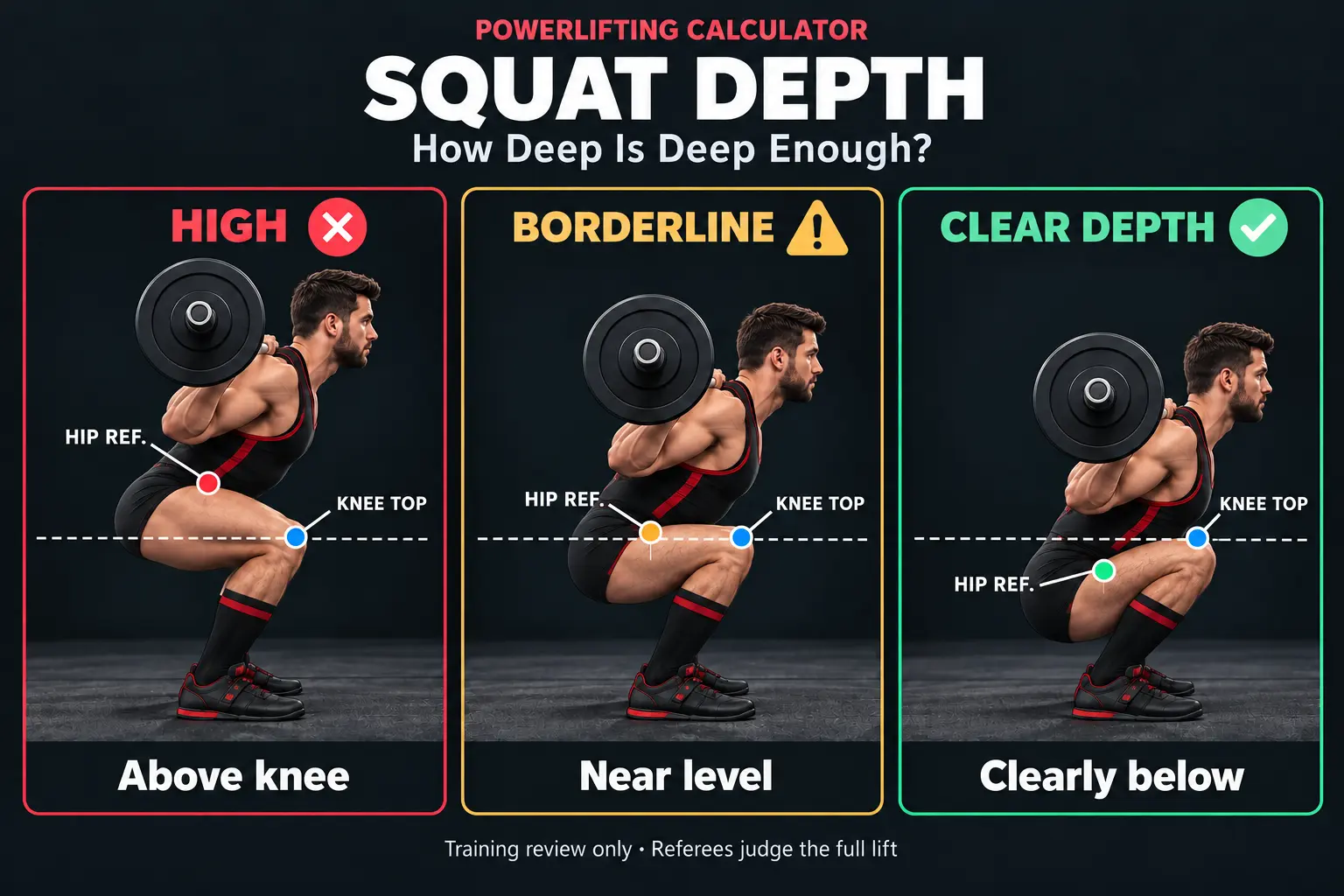
- HIGH ✕: The hip reference is above the knee reference. A hard rep or a low-looking torso does not change that relationship.
- BORDERLINE ⚠: The landmarks look approximately level or are too close to separate confidently. Do not automatically count this as a legal lift.
- CLEAR DEPTH ✓: The hip reference is visibly below the knee reference in the view being reviewed. You still need the other requirements of a legal squat.
Build a small repeatable depth margin. The illustrations exaggerate the differences to make the idea clear; they do not prescribe an official minimum extra distance.
Why Camera Angle Can Lie
A camera above the athlete looks down across the thigh. A camera close to the floor looks up. Filming far in front of or behind the athlete changes which surface you can see. A wide-angle phone lens, especially close to the lifter, can further distort proportions. Camera tilt also makes an on-screen horizontal line a poor substitute for the actual level platform.
For training footage, record approximately at hip height, from the side or slightly forward of the side. Keep the phone level, stand far enough back to avoid an extreme wide-angle view and include the entire athlete. Keep both landmarks unobstructed. Use the same setup across sessions so comparisons are useful.
This filming recommendation does not specify where competition referees should sit. Their positioning follows their federation's rules. A phone view and a referee's live view are not interchangeable, and neither extra zoom nor a line overlay corrects perspective.
How to Check Your Own Squat Depth
- Record a heavy squat you would use for competition preparation. Include the descent, bottom and recovery. Review warm-ups too, but do not assume their depth carries over to heavier attempts.
- Pause at the deepest position. Step through the neighbouring frames so you do not select one just before the bottom.
- Identify the top of the knee. Use the upper knee surface, rather than its centre or the top of a sleeve.
- Identify the hip reference. Find the upper/front thigh surface at the hip, rather than clothing or the rear of the pelvis.
- Visualise a horizontal knee line. Use a level, useful camera view and the same visible side for both marks.
- Compare the vertical positions. If the hip is near level, improve your filming and build a little more depth margin.
If you need extreme zoom, multiple angles and a long debate to prove it was legal, build a little more depth margin. If the landmark is hidden, use a better recording rather than guessing its position.
Check Your Squat Depth
Not sure whether your squat is clearly below parallel? Use the Squat Depth Checker to compare your marked hip and knee positions at the bottom. It measures the image you supply, not your anatomy or the federation's verdict.
Squat Depth Checker
Select a bottom-position screenshot, then mark the top of the knee and the top surface of the leg at the hip joint, on the same visible side. A clothing fold, belt edge or knee centre is not the reference.
The Squat Depth Checker does not determine whether a competition lift is officially good or bad. Final decisions are made by referees under the rules of the federation running the meet.
JPG, PNG or WebP · up to 20 MB · choose a still image with both landmarks visible.
Upload an image to begin.
Tap to place a point. Use the adjustment buttons for precision, or focus the image and use Enter / arrow keys. Mark Knee and Mark Hip let you replace either point.
Your image is processed locally in your browser and is not uploaded to our server. The checker does not save it.
How the comparison works
The tool compares your two manually selected vertical positions. The borderline band is ±3% of the image-space distance between the knee and hip marks. Both distance and vertical separation use original-image coordinates; resizing the display does not change the result. This is an illustrative uncertainty band, not a federation tolerance, a validated biomechanical measurement, or a guarantee of legal depth. Cropping around the athlete is helpful. Camera tilt, perspective, hidden landmarks and your point placement can overwhelm this band. Nearly coincident points cannot be compared. A static image cannot assess commands or the full lift.
The Biggest Mistake: Training to the Absolute Minimum
At light weights you may descend comfortably below the reference. At 95%, you may cut the last part of the descent as the load feels heavier, the brace becomes harder to maintain or confidence drops. Fatigue can also change how you reach the bottom. These are reasons to review your own heavy footage, not claims that every lifter gets shallower under load.
If your training target is exactly the boundary, a small change can leave the next rep high. Aim slightly deeper than minimum legal depth while retaining your brace, balance and normal recovery. You do not have to chase an unnecessarily “ass-to-grass” squat.
Why Heavy Squats Can Become Higher
Compare your working sets around 80% with your heavier singles and last warm-up. Does your stance change? Do the knees stop travelling earlier? Do you rush the reversal, or lean forward without actually lowering the hip reference? A change in descent rhythm can be easy to miss when all your attention is on standing up.
Review your last warm-up, planned opener and meet-style singles, rather than testing 100% merely for a depth check. Use the 1RM Percentage Calculator to understand loads within your existing programme. If depth deteriorates, work with your coach on a load and technique you can repeat.
High-Bar vs Low-Bar: Judge the Landmarks
High-bar squats often look more upright; low-bar squats often involve more torso lean and a different distribution of hip and knee movement. Individual proportions and technique matter, so neither appearance is universal. A forward lean does not prove depth, and an upright torso does not guarantee it.
The relevant depth requirement still applies. Use your actual competition bar position when practising. Bar placement itself also has federation rules: for example, the 2026 IPF rules specify a lower placement limit at posterior-deltoid level. Do not treat “low-bar” as permission for any placement.
Does Stance Affect Depth?
Yes: stance width and toe angle influence how you reach the bottom. Hip anatomy, femur length, ankle mobility, footwear and bar position also influence the available movement and its appearance. There is no single stance that makes every lifter strongest at clear depth.
Change one variable at a time during planned training. Film the result, check the same landmarks and see whether you can maintain balance and a repeatable descent. A wider stance does not relax the depth rule. Neither does changing shoes or wearing equipment.
Can You Squat Too Deep?
Extra depth itself is not listed as a depth failure in the verified squat sections. Performance is a different question: travelling farther than necessary adds range of motion, and some lifters lose their best position if they chase maximum depth. Others lift well from a deeper bottom.
The useful target is clearly below, repeatable and strong. Choose a bottom position you can control under your meet loads. Going deeper does not excuse a double bounce, a lost finish or any other rule violation.
Squat Depth Is Only One Part of a Legal Squat
In the verified IPF, USA Powerlifting and cited WPC texts, the squat uses SQUAT → RACK signals. Establish the required upright, controlled position with locked knees, wait for SQUAT, complete the descent and recover to the required finish, then wait for RACK.
Those texts also prohibit double bouncing or repeated recovery attempts, and stepping or resetting the feet during the lift. IPF describes downward movement during ascent; USA Powerlifting specifically refers to downward movement of the whole bar in its entirety. WPC allows a stop but no downward motion during recovery. Their detailed failure lists differ, including contact and returning the bar to the rack. Read the actual section for your event; confirm WUAP's current commands and failure criteria in its current book.
A bottom-position screenshot cannot assess any of these. A clear result from the checker means only that your selected points have a clear vertical separation in that image.
How to Practice for Meet Day
Use your competition stance, shoes and bar position. Ask a training partner to give the signals, then film your planned opener and other appropriate meet-style work. Review the full rep as well as the bottom frame. Practice holding the finished position instead of walking toward the rack as soon as the weight comes up.
Repeatability beats occasional extreme depth. Review several reps across sessions; one deep rep does not establish a reliable opener. If you regularly need to ask whether the squat was deep enough, make the next rep slightly deeper while maintaining control.
Choose an opener you can execute to clear depth under commands, even when the platform feels unfamiliar. Our Powerlifting Attempt Selection Guide explains how to choose your opener, second and third attempts. Use the Attempt Planner to record that plan and the Plate Loading Calculator for warm-up loading.
Squat Depth Checklist
- Can I reach the required depth with my heavy competition-preparation loads?
- Does my depth stay consistent across reps and sessions?
- Have I filmed from a level, useful angle with both landmarks visible?
- Can I maintain my brace and balance at that depth?
- Do I know my federation's commands and other squat requirements?
- Can I finish with locked knees and wait without rushing the rack signal?
Squat Depth by Federation
Source check: 10 October 2026. The wording below is paraphrased. “Hip crease below knee” is useful shorthand, but the federation's own anatomical wording remains the reference.
| Federation | Depth standard | Relevant notes | Official source |
|---|---|---|---|
| IPF | Upper leg surface at the hip joint lower than the knee tops. | Level does not meet the stated lower-than requirement. Classic and equipped use the squat performance section. | 2026 Technical Rulebook v3, effective 1 March 2026, §§4.1–4.1.1. |
| USA Powerlifting | Top/anterior upper leg surface at the hip joint lower than the knee's top surface. | Explicitly identifies the hip reference as the inguinal crease. This book covers national/pro and lower-level USAPL events; it does not govern IDFPA international events. | Rulebook v2026.2, updated 9 February 2026; in effect 1 January 2026, §§4.1–4.2. |
| WUAP | Current international depth wording could not be independently re-read during this update. | The official site lists v3.5, dated 1 March 2026. Its hosted document was inaccessible for this audit. Confirm the exact wording and national variations with the federation; do not assume another federation's text is identical. | Official WUAP site: Documents / Rulebook v3.5. |
| WPC | The cited book requires the upper leg surface at the hip joint below the knee tops. | Verified in the accessible 2021 Edition, not certified as a fully current 2026 consolidated book. The legacy download on the rules page did not resolve. | Official Rule Book, 2021 Edition, Squat §3 and disqualification §5; check official updates. |
Before entering: Confirm the book and any applicable national or meet-specific instructions. A shared below-knee principle does not make every setup rule, command detail or judging procedure identical.
Squat Depth FAQ
Does your hip crease have to go below your knee?
USA Powerlifting explicitly names the inguinal crease as its hip reference. IPF and the cited WPC book describe the upper leg surface at the hip joint. Compare that reference with the knee's top, not its centre. Check your federation's wording.
Is parallel enough in powerlifting?
Not if “parallel” means the relevant landmarks are level. The verified definitions require the hip reference to be lower. A horizontal-looking femur or thigh underside is not a substitute for that comparison.
How deep should I squat in training?
For competition practice, aim for a small, repeatable margin below the required reference while preserving your strong position. Review heavy work and commands, rather than relying only on deep light warm-ups.
Does squat depth change between raw and equipped?
The verified squat sections do not offer a shallower depth standard simply because you wear supportive equipment. Equipment can change how you reach the bottom or hide landmarks. Confirm your federation and division's current rules.
Can a video prove the referee was wrong?
A useful video may inform a review, but a phone screenshot or this checker does not reverse a decision. IPF's 2026 book describes jury-controlled instant replay procedures. Follow the applicable federation's protest and review process, rather than treating a social-media line overlay as an official ruling.
Can you squat too deep?
Extra depth is not itself a depth failure in the verified sections. It may be inefficient for your technique, and other faults can still invalidate the lift. Aim for a clearly legal, controlled and repeatable position.
Does stance width change legal depth?
No. It changes the movement and the view of it, not the required landmark relationship. A wide stance, low-bar technique or equipped suit does not grant a higher depth boundary.
Your Training Target: Clearly Below, Repeatable, Strong
Do not chase maximum possible depth or live exactly on the borderline. Find the hip and knee references, review heavy work from a useful angle and practise a small margin you can reproduce. Then complete the rest of the lift under your federation's rules.
Preparing for a Powerlifting Meet?
Squat depth is only one part of getting three white lights. Learn the bench commands and common red-light mistakes in our Powerlifting Bench Press Rules & Command Trainer. Then use the Attempt Selection Guide to plan your three attempts.
New to competition? Read the First Powerlifting Meet Guide and use its preparation steps alongside this depth checklist.
Powerlifting Rules
- Squat Depth — you are reading this guide.
- Bench Press Rules & Command Trainer — practise the signals and compare federation requirements.
More federation comparisons will join this Rules Hub as new guides are published.
Official Sources and Verification Notes
- IPF Technical Rules index and the v3 PDF linked above: squat §§4.1–4.1.1 and jury/replay procedures.
- USA Powerlifting Rulebook index and v2026.2 linked above: squat §§4.1–4.2. The separately linked 2026 supplement could not be read in this audit; event-specific updates should be checked with USAPL.
- WUAP official site lists international Rules v3.5, 1 March 2026. Current squat text remains unverified here because its linked file was inaccessible. We have not substituted an older or national book as the current international standard.
- WPC Official Rules index, its accessible 2021 Edition PDF, and Rules/Organization Updates. The updates page displayed historical entries; it does not establish that the 2021 PDF contains every current change.
This guide separates verified rules from practical training suggestions. The live federation rules and authorised officials determine competition results. The checker is a manually marked image comparison, with no AI judging or automatic anatomy detection.