Your first powerlifting meet can feel complicated even when squat, bench press and deadlift training already feels familiar. You know how to lift; the uncertainty is everything around it: entry forms, commands, equipment checks, warm-up timing and what happens after a missed attempt.
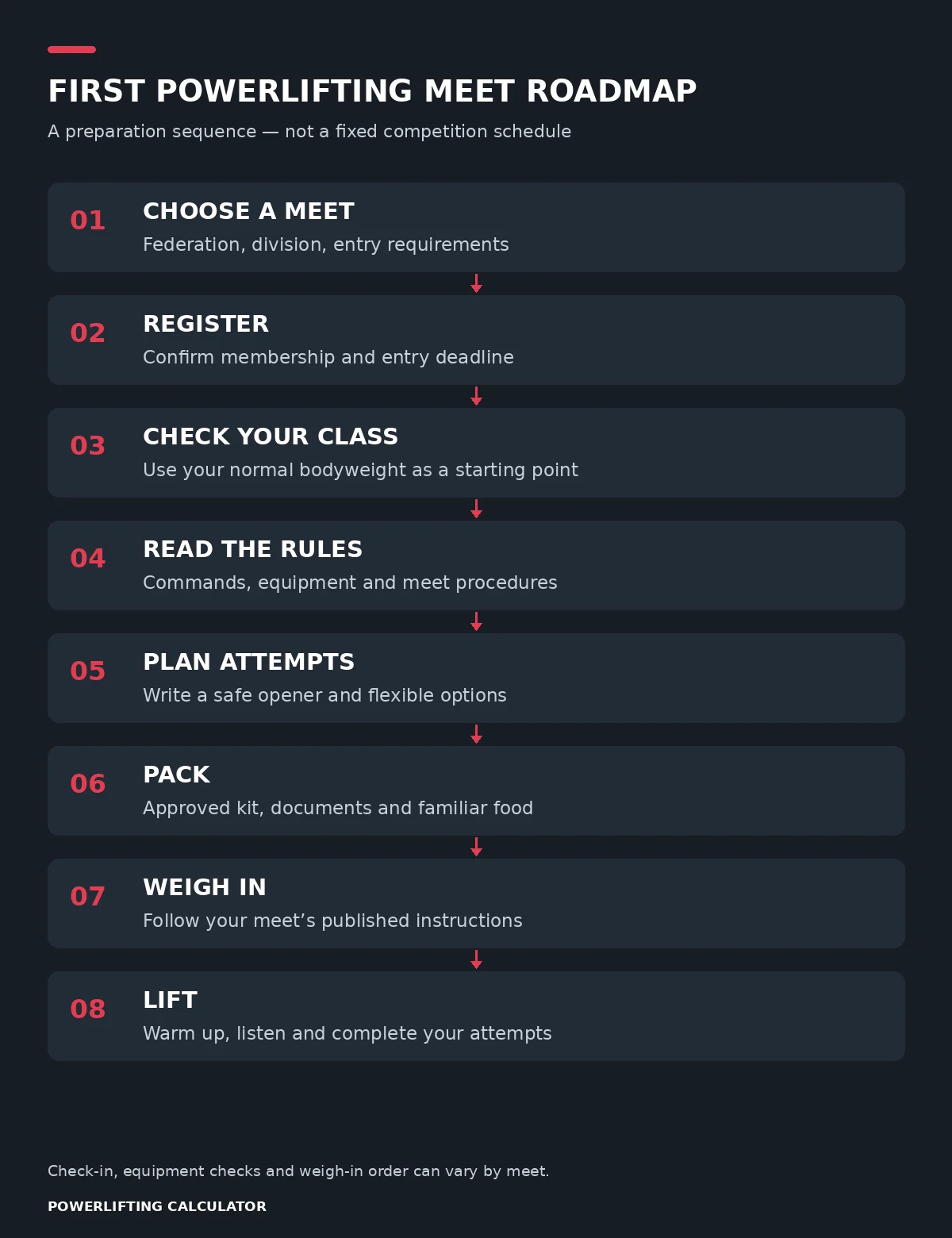
This guide takes you from choosing a competition to completing your final deadlift. The aim is a manageable first competition: arrive prepared, put valid lifts on the scoreboard and leave with useful experience for your next meet.
1. Choose the Right Powerlifting Meet
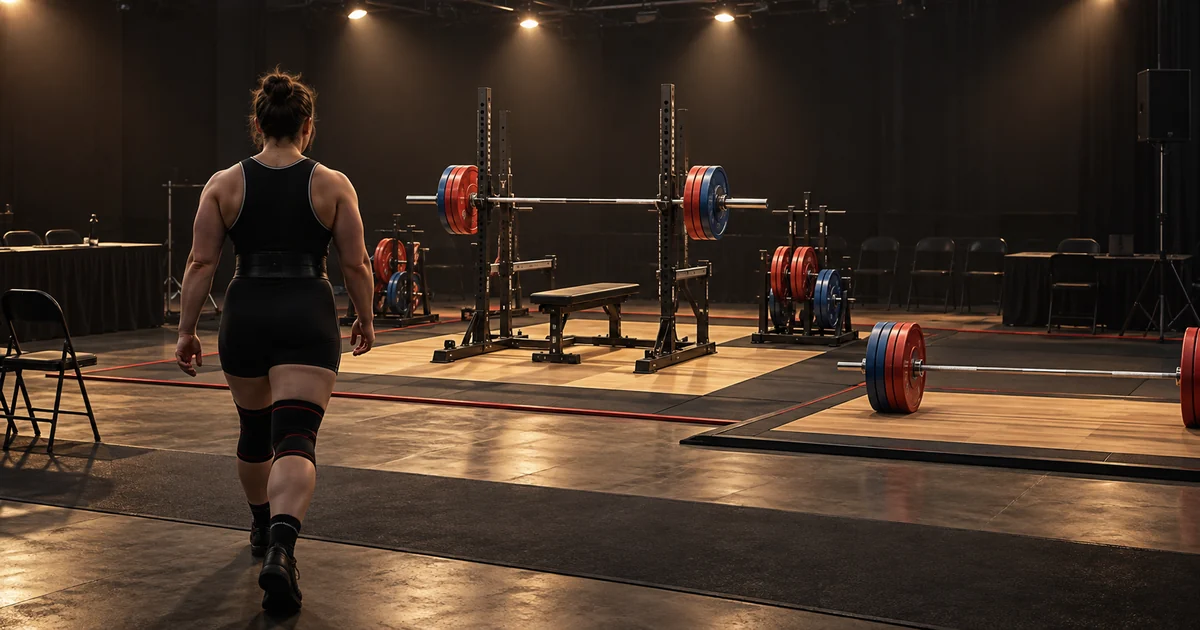
A nearby beginner-friendly competition is often easier to manage than an event requiring substantial travel. Check the sanctioning federation, location, entry deadline and whether the event welcomes first-time lifters or requires a qualifying result.
Read the entry form carefully. Raw, classic and equipped categories are not interchangeable, and the meaning of “raw” can differ between organisations. Check tested or non-tested status where applicable, age division, available weight classes and membership requirements. If anything is unclear, contact the organiser before paying.
Use our Competition Calendar to find a powerlifting competition, then verify details with the official event page. For a more detailed comparison, see how to choose a powerlifting meet.
2. Understand Your Weight Class
A class number is generally a bodyweight limit or classification, not a target you must reach. You do not need to fill every kilogram of a class to belong in it. Start with your normal, measured bodyweight and the categories offered at your event.
For a first competition, avoid adding an aggressive weight cut to an already unfamiliar day. Confirm what happens if your official weigh-in weight falls outside your nominated class; moving to another category is not something you should assume will be permitted.
Check your weight class → Use the tool as a planning reference, then read Powerlifting Weight Classes Explained and confirm your eligibility with the organiser.
3. Read the Rulebook Before Meet Day
Gym habits are not automatically competition standards. Read the sections covering lift performance, commands, equipment and attempt submissions. Know the required squat depth, bench position and pause, and deadlift finish before your final training sessions.
- Squat: wait for “Squat”, reach the required depth with the top of the thigh at the hip joint below the top of the knee, finish upright and wait for “Rack”.
- Bench: follow “Start”, hold the bar motionless for “Press”, complete the lift and wait for “Rack”. Position and depth requirements also apply.
- Deadlift: finish upright with locked knees, then wait for “Down” before lowering under control.
This is a short orientation, not a complete rule summary. Check your own federation’s wording and technical requirements.
Read the official IPF Technical Rules if you compete under IPF rules. Other federations publish their own requirements.
4. Practise Competition Commands
Ask a training partner or coach to call the commands used at your meet. Rehearse the entire attempt: taking your position, waiting, lifting, holding the finish and returning the bar. A lift can feel physically comfortable yet become confusing when you are waiting for a voice instead of moving on your own timing.
5. Plan Your Attempts
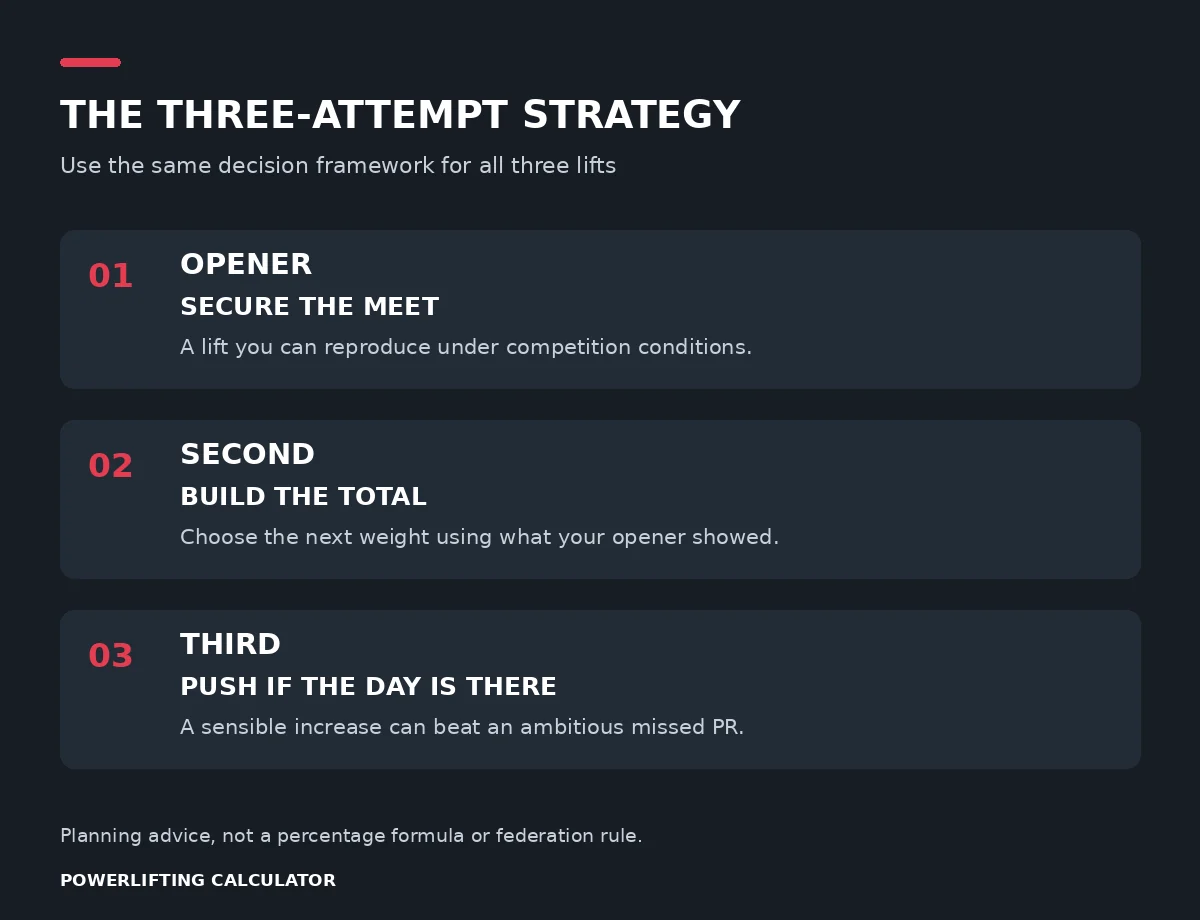
Write a plan for each lift, with options rather than three immovable numbers. The opener should be dependable under competition conditions. Use the second to build your result and the third to respond to the strength you actually have that day.
A reliable gym lift performed with competition technique is a better reference than an old personal record or a repetition that ignored the commands. If an opener is slower than expected, a smaller planned increase may make sense.
| Lift | Opener | Second | Third |
|---|---|---|---|
| Squat | 180 | 190 | 200 |
| Bench | 125 | 132.5 | 140 |
| Deadlift | 215 | 230 | 240 |
These numbers are not recommendations for your strength level. For the full reasoning, read Powerlifting Attempt Selection. Plan your meet attempts → The planner is an editable worksheet; check every suggested weight before using it.
6. What to Bring to a Powerlifting Meet
Pack ahead of travel, using the rulebook and your organiser’s instructions. “I use it in training” does not establish that a piece of equipment is permitted in your competition category.
Competition equipment
- Required lifting clothing, such as an approved singlet and T-shirt where applicable.
- Suitable shoes and any required socks, including deadlift socks where specified.
- Belt, wrist wraps and knee sleeves or wraps only where permitted.
- Any additional federation-required items; check brands, sizes and category restrictions.
Documents
- ID and membership or registration information.
- Meet confirmation and any forms requested by the organiser.
- Your opening attempts and rack-height notes where relevant.
Practical items
- Water and familiar food.
- Towel, warm clothing and spare clothing.
- Phone charger, attempt notes and headphones if useful.
- Travel, parking and venue information saved somewhere accessible.
7. What Happens at Weigh-In?
Check the published arrival and weigh-in arrangements before travelling. You may need to check in, present identification, have equipment inspected, record rack heights or submit opening attempts. The order and timing of these steps depend on the federation and event.
Officials measure and record your bodyweight under the applicable procedure. Follow their instructions, and ask promptly if you are unsure about your nominated category or paperwork. Do not rely on an assumed universal two-hour or day-before weigh-in.
Keep your attempt notes and relevant equipment accessible rather than buried in the bottom of a bag. Our Weight Class Checker helps with preparation; the official weigh-in determines the recorded competition bodyweight.
8. Eating and Drinking on Meet Day
Bring foods and drinks you already tolerate around training. Keep the plan simple and practical: food you can store safely, portions you can manage between lifts and fluids you can access throughout the day.
A first meet is a poor time to experiment with unfamiliar supplements, unusually large meals or an improvised dehydration strategy. If you have medical or dietary needs, make your plan with an appropriate professional before the event. This guide does not prescribe a weight-cut or recovery protocol.
9. How to Warm Up at a Powerlifting Meet
The warm-up room is shared. Find your flight or lifting group, identify which rack or bar you will use and communicate with the other lifters. Be ready to change plates and share equipment rather than expecting a private training station.
Work backwards from your estimated platform turn. Watch the actual lifting order and listen for updates; a printed start time is not enough if the session runs early or late. Use familiar weight jumps and avoid turning warm-ups into another workout.
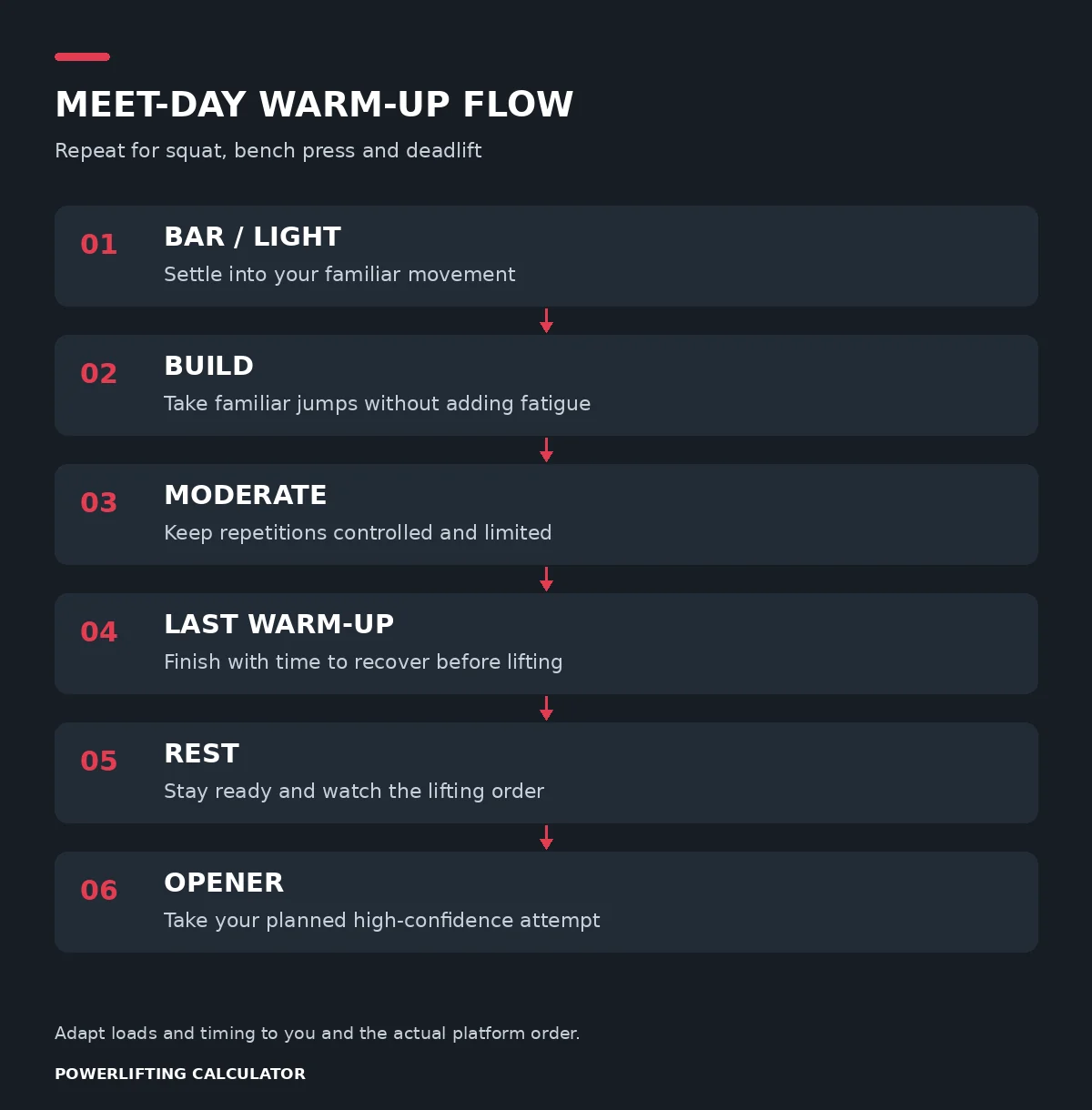
Finish your last warm-up with time to recover and reach the platform calmly. If timing becomes unclear, ask an experienced handler or meet official rather than guessing. Have your equipment ready before your name is called.
10. Meet Day: Step by Step
Your Meet-Day Timeline
Illustrative flow for a full three-lift meet. The order of check-in, equipment checks and weigh-in may differ.
- Arrive & Check In
- Equipment Check
- Weigh-In
- Eat / Hydrate / Prepare
- Squat Warm-Up
- Squat
- Bench Warm-Up
- Bench Press
- Deadlift Warm-Up
- Deadlift
- Final Total
Exact schedules, weigh-in procedures and equipment checks vary by federation and competition. Always follow your meet information and current rulebook.
This shows the broad flow of a full three-lift competition. Administration may happen in a different order, and each lift includes the attempts of other lifters in your group. Follow the organiser’s schedule and announcements throughout the day.
11. Squat: Start With a Dependable Lift
Confirm your rack setting, equipment and opener before your group begins. Use your normal warm-up cues, then focus on listening and completing the attempt rather than imagining the entire day at once.
After the result, identify what happened and submit your next weight within the event’s deadline. Let the first attempt inform your next choice. If nerves affected the lift, simplify your next attempt to one or two useful cues.
12. Bench Press: Reset After Squat
Check the transition to bench instead of assuming you have a long break. Locate the bench warm-up area, confirm your rack setting and discuss any permitted hand-off with the relevant person.
Remember the command and pause practice from training. After each attempt, deal with the result and next submission before becoming distracted by messages or videos. Your squat result is already recorded; give the bench its own clear plan.
13. Deadlift: Finish the Day With a Clear Plan
By deadlift, you may be tired and the warm-up room may feel different from the morning. Keep monitoring your group, use a familiar preparation sequence and avoid unnecessary extra pulls.
A third deadlift can be more tactical because it completes the total and may affect placing. For your first meet, completing a sensible final attempt can be more useful than chasing an arbitrary number. Discuss changes with your handler and verify what the rules allow. The Attempt Selection guide covers this decision in more detail.
14. What Does Going 9 for 9 Mean?
Going 9 for 9 means all three squat, three bench and three deadlift attempts were successful. It is a useful description of a meet, not the only definition of success. A first competition can teach you a great deal even with a missed attempt.
Record which attempts succeeded and why any were missed. For broader competition context, see our attempt-success analysis; its dataset is not a prediction for an individual beginner.
15. After Your First Meet
Save the official result and record your weigh-in bodyweight, best successful squat, bench and deadlift, and total. Add a few notes while the day is fresh: command errors, warm-up timing, equipment problems and which attempts felt well chosen.
Use the homepage calculator to review your numbers. Our Powerlifting Total guide explains the result, while the DOTS guide explains bodyweight-adjusted comparison. Keep equipment categories and scoring formulas consistent; the Methodology page documents the calculator’s limits.
Choose a small number of improvements for the next training block. When you are ready, return to the Competition Calendar and look for your next event.
16. Common First-Meet Mistakes
Opening too heavy
Choose something dependable under the meet’s standards, not something you hope adrenaline will rescue.
Not practising commands
Rehearse waiting and finishing with a partner before competition day.
Trying unfamiliar food
Bring familiar options instead of turning the event into an experiment.
Forgetting equipment
Pack from the event requirements and check the bag before leaving.
Ignoring the schedule
Keep watching your group and listening to announcements, even between lifts.
Poor warm-up timing
Plan around your actual turn rather than completing every warm-up as early as possible.
Unnecessary weight changes
Confirm your category early and avoid improvising bodyweight management at your first meet.
Making every third a mandatory PR
Let performance guide the choice. A smaller successful increase still improves your result.
17. Your First Powerlifting Meet Checklist
Before leaving home, confirm your entry, membership, class and schedule. Check equipment, rehearse commands, write attempts, pack familiar food and save the organiser’s contact details. On arrival, identify your group, complete the required administration and plan warm-ups around the actual lifting order.
Keep the free First Powerlifting Meet Checklist with your attempt notes. It includes packing lists, a warm-up worksheet and a printable attempt card. The PDF is delivered by email after confirmation; additional email tips are optional.
Frequently Asked Questions
What should I bring to my first powerlifting meet?
Bring the equipment required and permitted by your federation, identification, entry or membership information, attempt notes, water and familiar food. Check the event instructions for extra documents or equipment requirements.
How do powerlifting weigh-ins work?
Officials measure and record bodyweight using the event’s procedure. Check-in, equipment inspection, rack heights and opener submissions may happen alongside it. Timing and permitted re-weighs vary; follow the organiser and rulebook.
What should my opening attempts be?
Choose lifts you can reliably reproduce with competition technique and commands. Account for nerves and unfamiliar equipment. A percentage can support a plan, but it cannot establish that a lift is dependable.
How long does a powerlifting meet take?
There is no universal duration. It depends on the number of lifters, flights, platforms, disciplines and schedule. Ask the organiser for your session information and allow time for delays and travel.
Do I need a coach for my first powerlifting meet?
An experienced coach or handler can help with timing and decisions. Check the meet’s access and accreditation rules if someone will accompany you. If you attend without one, prepare carefully and ask officials how to navigate the process.
What happens if I miss an attempt?
Identify the reason, use the attempts remaining and submit the next weight under the rules. In IPF full meets, three failed attempts in one lift eliminate the overall total. Your federation determines continuation and individual-lift eligibility.
What does going 9 for 9 mean?
All nine attempts in a full meet were successful: three squat, three bench press and three deadlift. It describes attempt success; it does not establish how heavy the result was.
Can I change my attempts during a powerlifting meet?
Only within the applicable rules and deadlines. Do not assume a submitted weight can be changed or reduced. Check the organiser’s procedure and our Attempt Selection guide before you submit an adjustment.
Sources and Scope
This is general preparation advice, not a personalised training, nutrition or weight-cut programme. The explicitly labelled IPF example was checked on 30 September 2026 against the English Technical Rulebook effective 1 March 2026, version 3, especially sections 4 and 6. Other federations and individual events may differ.
- IPF Technical Rules — official current rulebook and updates.
- USA Powerlifting — official rulebook hub, for competitors in that federation.
- Powerlifting Calculator — formulas, units and limitations.